
Windows 365 for Law Firms: Security, Ethics, and Where It Fits
-
 13 October 2026
-
 Windows 365
 -
 Written by
Editorial Team
Written by
Editorial Team
Windows 365 can be a strong fit for law firms that want client files off laptops and a Windows desktop attorneys can use from anywhere, but it is a desktop layer, not a complete legal technology stack. It gives each user a secure Cloud PC managed through Microsoft Intune and protected with Microsoft Entra Conditional Access, so work stays in the Microsoft cloud instead of on a device that can be lost or stolen. It does not replace your document management system, your retention and legal hold process, or the server behind a legacy practice management tool. Knowing where that line sits is the difference between a smooth rollout and an unpleasant surprise.
This guide is written for managing partners, firm administrators, and the IT providers who support them. It explains how Windows 365 relates to the ethics rules that govern client confidentiality, which security controls matter most, which roles fit which Windows 365 options, the limits Microsoft documents for networking, data allowances, and Cloud PC deletion, and a practical deployment checklist. It is general information, not legal advice, so confirm your obligations against your state bar’s rules.

Windows 365 for Law Firms at a Glance
- What it is: A persistent Windows 11 desktop for each user, hosted in Microsoft’s cloud and reached through the Windows App, a browser, or a Windows 365 Link device.
- Best for: Firms with attorneys and staff working from home, court, or client sites, firms replacing aging desktops, and firms that want less client data on endpoints.
- What it supports: The “reasonable efforts” standard for client confidentiality under ABA Model Rule 1.6(c), through access controls, device management, encryption, and limits on data movement.
- What it does not replace: Your document management system, retention and legal hold, ethical walls, or server-based practice management software.
- Check first: Whether your applications need a connection to a server. That decides between Windows 365 Business and Enterprise.
What Windows 365 Is, and Is Not, in Law-Firm Terms
Windows 365 streams a personal, persistent Windows 11 desktop, called a Cloud PC, from Microsoft’s cloud to whatever device an attorney is using (if the idea is new to you, here is how a Cloud PC works). Applications, files, and settings stay on the Cloud PC between sessions. Every Cloud PC is joined to Microsoft Entra ID and enrolled in Intune, so it is ready for Conditional Access and device policies from the moment it is provisioned, according to Microsoft’s Cloud PC lifecycle documentation.
Just as important is what it is not. A Cloud PC is not a document management system, not a matter-centered archive, not a backup of your client files, and not a practice management server. It is where your people work. The system of record for matter files should still be your document management system, SharePoint, or whichever platform your firm uses. Think of the Cloud PC as a secure workspace, not a filing cabinet. That framing prevents most of the mistakes covered later in this guide.
Is Windows 365 a Good Fit for Your Firm?
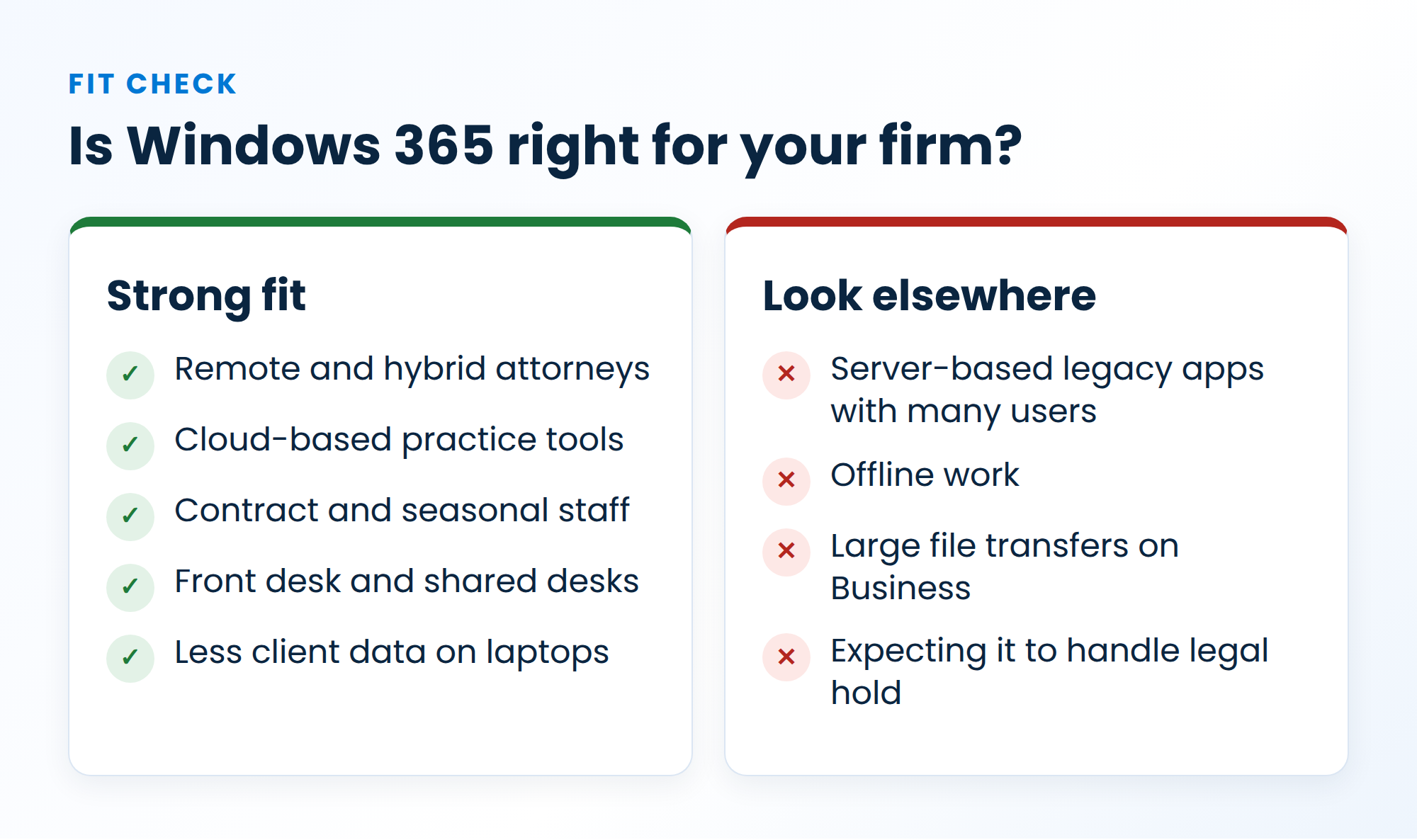
Fit depends less on firm size than on how your people work and where your applications and data live. This quick check separates the usual strong fits from the situations that need a different approach.
-
Strong Fits
Remote and hybrid attorneys who need the same desktop at home, at court, and at the office. Firms that use cloud-based practice management and document management tools through a browser or Office apps. Firms that bring in contract attorneys or seasonal staff on set schedules. Reception desks and shared workstations. And any firm that wants less client data sitting on laptops that travel.
-
Situations That Need a Different Approach
Firms whose practice management or accounting software must sit beside a database server with many people connected at once. Staff who need to work offline. Workflows that move very large files on a Windows 365 Business plan, which has monthly outbound data allowances. And firms expecting Windows 365 itself to handle legal hold, which it does not.
What the Ethics Rules Ask of You
No ethics rule says a firm must use Windows 365, or must use the cloud, and no rule makes a product “ABA compliant.” What the rules ask for is a reasonable process. Model Rule 1.1, comment 8, says competence includes keeping up with the benefits and risks of relevant technology. Rule 1.6(c) requires reasonable efforts to prevent inadvertent or unauthorized disclosure of, or access to, client information. Rule 5.3 extends the duty of supervision to nonlawyer assistance, and ABA guidance applies it to outside vendors that handle client data.
ABA Formal Opinion 477R (2017) takes a fact-specific approach: whether your efforts are reasonable depends on factors such as how sensitive the information is and how hard the safeguards are to apply. Formal Opinion 498 (2021) applies these duties to virtual practice and makes clear the same rules apply wherever the work happens. Formal Opinion 08-451 adds guidance on selecting and supervising outsourced providers. State bars publish their own opinions, which vary, so check yours.
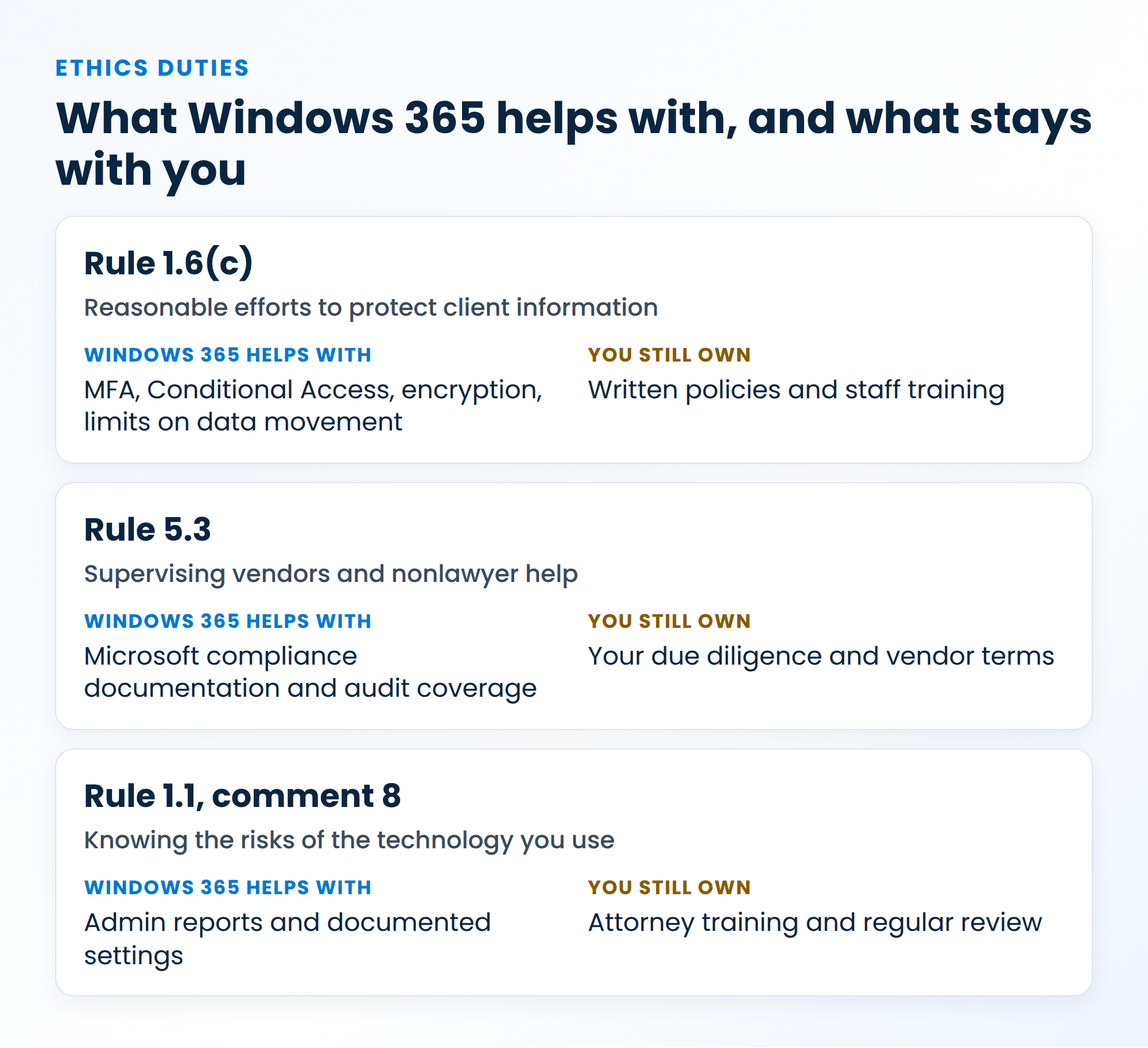
So the right question is not whether Windows 365 is compliant. It is whether your firm can show reasonable efforts. Windows 365 gives you strong building blocks, and your firm supplies the policies, training, and vendor review around them. Keep records of your configuration choices, your review of Microsoft’s documentation, and your staff training, because “reasonable efforts” is something you may need to demonstrate later to a client or a bar committee. Our piece on what SOC 2 evidence can show explains how audit reports fit into that record.
If your firm is still deciding whether to use cloud services at all, our broader look at moving firm systems to the cloud covers the due diligence questions to ask any provider.
Questions to Ask Any Provider Before You Sign
Rule 5.3 asks you to supervise the vendors that touch client data, and the most practical way to do that is to ask good questions up front and keep the answers. Whether you buy Windows 365 through a cloud solution provider or manage it yourself, these are worth putting in writing.
- Who can access our data, and is that access logged? You want named roles, not a vague assurance.
- Where are Cloud PCs and data stored, and can we choose the region? Some clients and engagement letters care about location.
- Which compliance reports can you share? Ask for current SOC 2 Type 2 or ISO documentation, not just a logo on a web page.
- How are security incidents handled, and how fast will we be told? Your own notification duties may start when theirs does.
- What do backups cover, and what do they leave out? A Cloud PC is not automatically a backup of your matter files.
- How are offboarding and legal holds handled? Make sure deletion timing never collides with a preservation duty.
- What support is included, and when is it available? Attorneys work evenings and weekends, so support hours matter.
- What happens to our data if we leave? Get the exit process in the agreement.
Security Controls That Matter for Client Confidentiality
Windows 365 includes a long list of controls. These six do the most work for a law firm, and each one maps back to the “reasonable efforts” standard above.
-
1. Identity and Access
Access is controlled through Microsoft Entra Conditional Access, which can require multi-factor authentication, compliant devices, and other conditions before an attorney reaches a Cloud PC. There are two authentication steps, one for the Windows 365 service and one for the Cloud PC itself. Microsoft also lets you exclude Windows 365 from device compliance policies so attorneys can reach their Cloud PCs from a personal device while you still enforce multi-factor authentication and sign-in risk checks. Our steps for hardening Cloud PCs walk through the settings.
-
2. Control Over How Data Moves
Clipboard, drive, opaque USB, and printer redirection have been turned off by default on newly provisioned and reprovisioned Cloud PCs since June 2025, so files do not leave the session unless you allow it. Administrators can also set a one-way clipboard, and Microsoft has a context-based redirection feature in public preview that adjusts redirection by device compliance, user group, and network location. For highly sensitive matters, screen capture protection and traceable watermarking help discourage photographs and screenshots, although they depend on a supporting client. Printing is where firms usually feel the friction, so plan it deliberately instead of discovering it during the pilot.
-
3. Encryption and Keys
Cloud PC disks are encrypted at rest with AES-256 through Azure Storage server-side encryption, and encryption at host can be added for Enterprise Cloud PCs. Firms that want to hold their own keys can use Microsoft Purview Customer Key with Windows 365.
-
4. Endpoint Protection and Patching
Because every Cloud PC is enrolled in Intune, you can apply compliance policies and the Windows 365 security baseline, and connect Microsoft Defender for Endpoint to assess device risk. Windows Update keeps quality updates current, so attorneys are not relying on a home laptop that has not been patched in months.
-
5. Compliance Coverage
Microsoft’s Windows 365 compliance overview lists ISO/IEC 27001, ISO 22301, ISO/IEC 27017, ISO/IEC 27018, ISO/IEC 27701, SOC 2 Type 2, FedRAMP, HIPAA, and HITRUST, and describes support for regional data residency. If your firm handles health information, such as in personal injury, medical malpractice, or benefits work, ask your counsel whether you need a business associate agreement and how to configure the environment around it.
-
6. Lost and Stolen Devices
The ABA’s Legal Technology Survey Report asks whether a firm has ever experienced a security breach, and about a quarter of respondents say yes. The survey’s definition includes events such as a lost or stolen computer or smartphone, not only hacker attacks. A Cloud PC keeps the working files off the device, so a lost laptop is far less likely to mean a lost client file. If an attorney leaves or a device goes missing, you can block access immediately by disabling the account and revoking refresh tokens.
Cloud PC vs VPN for Remote Attorneys
Many firms handled remote work by adding a VPN. A VPN extends the office network to an attorney’s laptop, but the laptop still holds the files and applications, so a compromised or stolen device is still a problem. A Cloud PC moves the work itself into the cloud, and with redirection limited, the laptop becomes little more than a screen and a keyboard. That is a meaningful reduction in exposure, although it does not remove the need for multi-factor authentication, patching, and training. If you want the full comparison, here is how virtual desktops compare with VPNs.
Matching Roles to Windows 365 Options
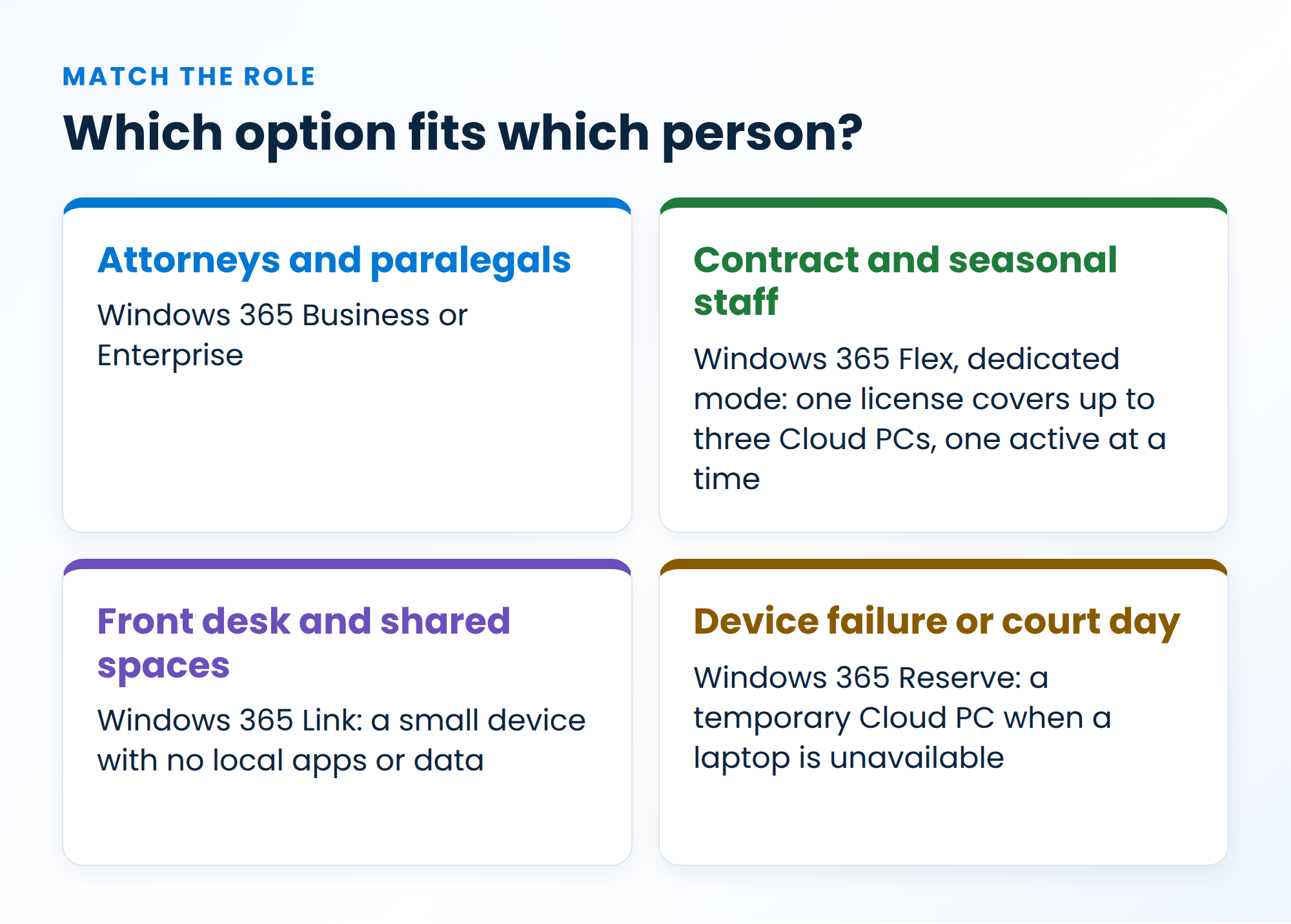
A law firm is not one kind of user, and Windows 365 is not one product. Matching each group to the right option keeps both security and cost sensible.
-
Attorneys and Paralegals: Business or Enterprise
Windows 365 Business suits firms of up to 300 users, needs no Azure subscription, and places Cloud PCs on Microsoft-hosted networking. Windows 365 Enterprise has no user limit, requires Intune and Microsoft Entra ID P1 along with Windows Enterprise licensing, and can connect Cloud PCs to your own Azure network. Your applications usually decide which one you need, which we cover below.
-
Contract Attorneys and Seasonal Staff: Flex in Dedicated Mode
One Windows 365 Flex license covers up to three Cloud PCs assigned to different people, with only one active at a time. That fits contractors and part-time staff who work on set schedules, and it makes ending an engagement simple. It does not suit three people who need to work at the same moment.
-
Front Desk and Shared Spaces: Windows 365 Link
Windows 365 Link is a small device that runs no local apps and stores no local data, which suits reception desks that visitors walk past. It requires Intune and single sign-on on the Cloud PC. Our guide covers a purpose-built Cloud PC device for shared desks in detail.
-
Device Failure or Court Day: Windows 365 Reserve
Windows 365 Reserve provides a temporary Cloud PC when someone’s own device is unavailable. For an attorney whose laptop fails the morning of a filing deadline, that can be the difference between working and waiting.
Not Sure Which Option Fits Each Role in Your Firm?
Tell us how your attorneys, paralegals, and contract staff work. We will map each group to Business, Enterprise, Flex, or Link and flag anything that needs a different approach.
Check Your Practice Management Software First
This is the single most common surprise. A Cloud PC is a full Windows desktop, so Windows applications generally install and run. The question is whether the application can reach what it depends on. Many desktop practice management and accounting tools expect a database or a file share close by. Microsoft’s Business and Enterprise comparison notes that Business uses Microsoft Entra join without Azure virtual network support, while Enterprise can place Cloud PCs on your own Azure virtual network.
In practice that gives you three paths. If your tools are cloud-based, Business is often enough. If your firm runs server-based software, Enterprise on an Azure network connection puts the Cloud PCs near the servers. Or you can host the application and its data together in a managed environment, which keeps many users on one stack. For a desktop practice management product, that can mean hosting the application beside its data, and for a wider view of that route see our managed cloud services built around legal applications. Always check your software vendor’s requirements before you decide.
Limits to Know Before You Commit
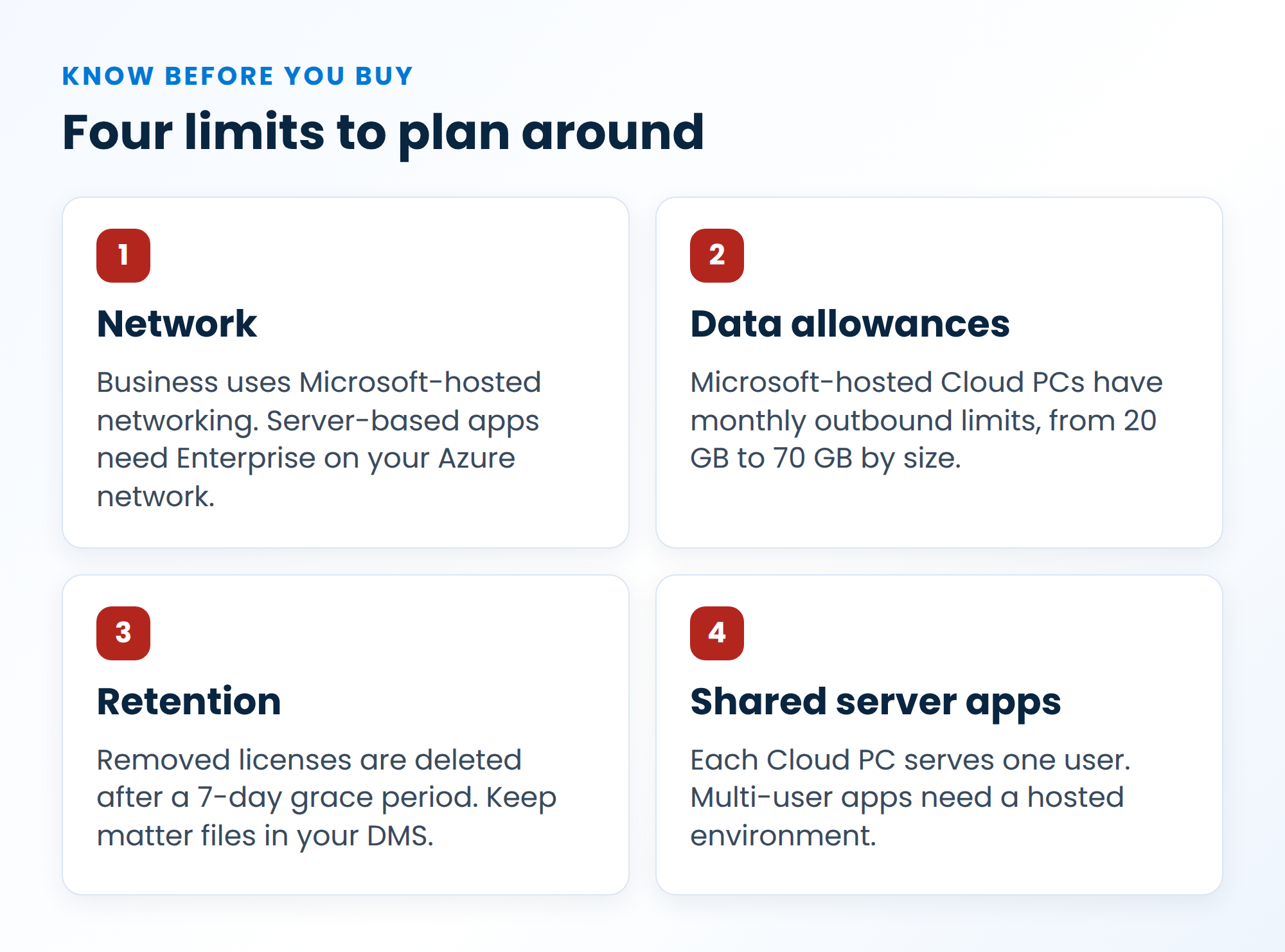
Windows 365 is simple to run, but it has boundaries that matter to law firms. Plan around these four.
-
Monthly Data Allowances on Microsoft-Hosted Networking
Microsoft’s network requirements set monthly outbound data allowances for Cloud PCs on Microsoft-hosted networking, based on memory: 20 GB for 4 GB and 8 GB sizes, 40 GB for 16 GB, and 70 GB for 32 GB. Microsoft says bandwidth may be restricted when the allowance is exceeded. Firms that move large productions or discovery sets should monitor usage, or use Enterprise on their own network, where Azure bandwidth charges apply instead.
-
The Cloud PC Is Not Your System of Record
If you remove a user’s license or provisioning policy, the Cloud PC enters a seven-day grace period, and afterward Windows 365 deprovisions the Cloud PC and its storage completely. That is good for clean offboarding and a problem for retention. Keep matter files in your document management system or Microsoft 365, and decide in advance how legal holds will be preserved before a license is ever removed.
-
One User per Cloud PC
Each Windows 365 Cloud PC serves a single user. Applications that rely on many people sharing one server session need a different design, such as how Windows 365 and AVD differ or managed desktops hosted for your firm.
-
Ethical Walls and Matter Permissions Live Elsewhere
Windows 365 does not enforce conflict screens or matter-level access. Those controls belong in your document management system and Microsoft 365 permissions. A Cloud PC makes them easier to apply consistently, but it does not replace them.
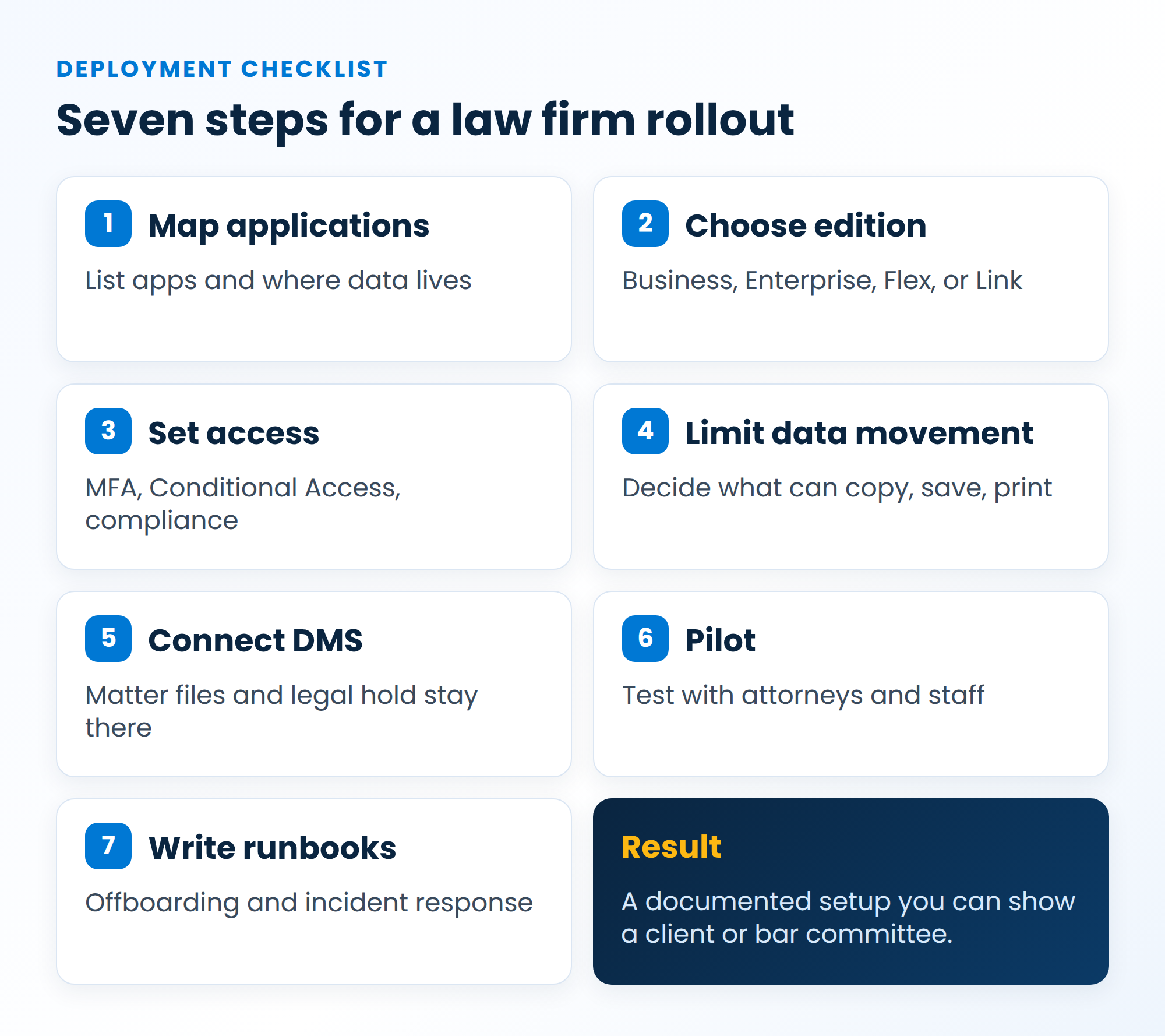
How to Deploy Windows 365 in a Law Firm in 7 Steps
A careful rollout takes weeks, not months, and the preparation matters more than the provisioning. Follow these steps in order and pilot with a handful of people before you move the whole firm.
-
Step 1: Map Your Applications and Data
List every application attorneys and staff use, where its data lives, and which tools need a server connection. Include the less obvious ones: e-filing portals, e-signature tools, scanners, PDF and discovery software, and anything that handles very large files.
-
Step 2: Choose the Edition and Network
Use the application map to choose Business or Enterprise, and decide which groups will use Flex, Link, or Reserve. Confirm Intune and Microsoft Entra ID licensing, and check the current plan pricing by edition before you finalize the plan.
-
Step 3: Set Identity and Access
Require multi-factor authentication, build Conditional Access policies, decide how personal devices are handled, and assign administrator roles with care. Passwordless sign-in with security keys is a good fit for attorneys who dislike password prompts.
-
Step 4: Decide What Data Can Move
Set redirection policies for clipboard, drives, USB, and printing, and decide which matters justify screen capture protection and watermarking. Write the rules down, because they are part of your evidence of reasonable efforts.
-
Step 5: Connect Document Management and Retention
Make sure matter files are saved in your document management system and that your backup and legal hold processes cover them. Do this before the pilot, so no one gets used to saving work only on the Cloud PC.
-
Step 6: Pilot With Attorneys and Staff
Test the real work: large PDFs, document comparison, court e-filing, video calls, scanning and printing, and your practice management tools. Ask people what slowed them down, and fix it before the wider rollout.
-
Step 7: Write the Offboarding and Incident Runbooks
Document who disables an account, who revokes tokens, how the seven-day grace period is handled, and how a lost device is reported. A written runbook is also part of showing that your firm acted reasonably.
Mistakes Law Firms Make With Windows 365
- Saving matter files only on the Cloud PC. When the Cloud PC is deleted, so is anything that lived only there.
- Assuming Business can reach a server. Business uses Microsoft-hosted networking, so server-based software needs a different design.
- Skipping the printing and scanning test. Redirection is off by default, and a pilot is the cheapest place to find that out.
- Treating watermarking as a guarantee. Watermarks and screen capture protection discourage leaks, but they are one layer, not a seal.
- Using one option for everyone. Contract staff, the front desk, and partners have different needs, and one-size licensing wastes money or leaves gaps.
- Leaving the settings undocumented. If you cannot show what you configured and why, you cannot easily show reasonable efforts.
What Windows 365 Costs for a Law Firm
At the September 2026 list prices we verified on Microsoft’s site, Windows 365 Business starts at $25.60 per user per month and Enterprise at $28.00 per user per month for the smallest 2 vCPU, 4 GB configuration, and most attorneys will want a larger size. Flex is priced per license rather than per user. Prices change, so confirm current rates before you budget. Sizing matters as much as the plan: our guide to ways to trim a Cloud PC bill shows how to avoid paying for capacity nobody uses.
Law Firm Readiness Review
See Where Windows 365 Fits Your Firm, and Where It Does Not
We will review your practice management software, document management system, and security obligations, then tell you plainly whether Windows 365, a hosted environment, or a mix of both is the better path.
The Bottom Line
Windows 365 is a good answer to a specific problem: giving attorneys and staff a secure, consistent Windows desktop without leaving client files on devices that travel. It supports the reasonable-efforts standard, it makes offboarding and lost devices easier to manage, and it fits remote and hybrid work well. It is not a records system, an ethics shield, or a fix for server-based software, and it works best when you pair it with a document management system, written policies, and trained people. Map your applications first, pick the option that fits each role, pilot with real work, and write down what you configured and why.
Talk to a Windows 365 Specialist About Your Firm
Get a clear plan before any attorney signs in.
Our Microsoft-certified consultants will review your applications and obligations, recommend the right Windows 365 options, configure the security controls, and support your attorneys and staff around the clock.
Frequently Asked Questions
-
Is Windows 365 secure enough for a law firm?
Windows 365 includes controls that support the reasonable-efforts standard for client confidentiality, including Conditional Access and multi-factor authentication, Intune device management, Microsoft Defender for Endpoint, AES-256 encryption at rest, and limits on clipboard, drive, and printer redirection. The result depends on how you configure it, so document your settings and review them regularly.
-
Is Windows 365 ABA compliant?
No product is ABA compliant, because the ABA does not certify technology. The Model Rules require lawyers to make reasonable efforts to protect client information and to supervise vendors, and Windows 365 can be one part of showing you did so.
-
Can lawyers ethically use Windows 365?
The ABA Model Rules do not prohibit using cloud services when a lawyer makes reasonable efforts to protect client information. ABA Formal Opinions 477R and 498 apply that standard to electronic communication and virtual practice, and state bars publish their own opinions, so check the rules where you are licensed.
-
Is Windows 365 HIPAA compliant for law firms that handle health records?
Microsoft lists HIPAA among the standards Windows 365 supports. Whether your firm is a business associate, which agreements you need, and how to configure your environment are questions for your counsel and your compliance advisor.
-
Which Windows 365 plan is best for a small law firm?
Windows 365 Business suits firms of up to 300 users that rely on cloud-based tools, because it needs no Azure subscription and uses Microsoft-hosted networking. Choose Enterprise when you need Cloud PCs on your own Azure network, central Intune management at larger scale, or more than 300 users.
-
Can Windows 365 run desktop legal software?
A Windows 365 Cloud PC is a full Windows desktop, so Windows applications generally run on it. What matters is whether the software can reach its database or file share. Enterprise on an Azure network connection, or hosting the application together with its data, may be needed, so check your vendor’s requirements.
-
What happens to a departing attorney’s Cloud PC?
Disabling the user account and revoking refresh tokens blocks access immediately. Removing the license or provisioning policy starts a seven-day grace period, after which Windows 365 deprovisions the Cloud PC and its storage. Keep matter files in your document management system so nothing depends on the Cloud PC itself.
-
Does Windows 365 replace our document management system?
No. A Cloud PC is a secure workspace, not a records system. Your document management system should remain the home for matter files, permissions, ethical walls, and legal holds.
-
Can staff print and save files locally from a Cloud PC?
Not by default. Clipboard, drive, opaque USB, and printer redirection have been turned off by default on newly provisioned Cloud PCs since June 2025. You can enable what each role needs, and Microsoft’s context-based redirection preview can vary those settings by device compliance, user group, and network location.
-
How does Windows 365 compare with a VPN for remote attorneys?
A VPN extends your network to the attorney’s device, which still holds files and applications. A Cloud PC keeps the work in the cloud and treats the device as a window into it. Either approach still needs multi-factor authentication, patching, and staff training.
-
Can contract attorneys use Windows 365?
Yes. Windows 365 Flex in dedicated mode lets one license cover up to three Cloud PCs assigned to different people, with one active at a time, which suits contractors and part-time staff on set schedules.
This article is general information about technology and does not constitute legal advice. Ethics and regulatory requirements vary by jurisdiction, so consult your state bar’s rules and qualified counsel.