
Cloud Server for Small Business: Which Option Actually Fits (2026 Guide)
-
 31 August 2026
-
 Cloud Desktop,Cloud Service
 -
 Written by
Editorial Team
Written by
Editorial Team
A cloud server for a small business means one of two things, and picking the wrong one is the most common mistake businesses make when moving off a physical server: a rented cloud server, which is infrastructure you configure and run applications on, or a hosted cloud desktop, which is a complete, fully managed Windows environment for people to actually work in. Both are real cloud servers. Both solve real problems. They are not interchangeable, and most of the confusion around this topic comes from providers, and guides, that only sell or explain one of the two.
This guide covers both paths honestly: what each one actually costs, how to tell which one your business needs, what changes on the security side, and what the process looks like if you’re moving off an existing physical server. If you already know you have a mixed need, and many small businesses do, the two paths aren’t mutually exclusive either.
What Is a Cloud Server, and What Problem Are You Actually Solving?
A cloud server, in the broadest sense, is computing infrastructure that runs in a data center instead of a closet in your office. Beyond that shared definition, the term splits into two genuinely different products depending on what you’re trying to accomplish.
If the problem you’re solving is “our files, our database, or our line-of-business application needs somewhere to live that isn’t a physical box we maintain ourselves,” you’re looking for a rented cloud server. It’s infrastructure. You install what you need on it, the same way you would on a physical server, except it lives in a data center with better power redundancy and network connectivity than most small offices can build themselves.
If the problem you’re solving is “our team needs somewhere to actually work, log in, open their applications, save their files, without us managing patches, backups, and licensing ourselves,” you’re looking for a hosted cloud desktop. It’s a complete, ready-to-use Windows environment. Nobody on your team needs to know what’s happening at the infrastructure level underneath it.
Confusing these two is understandable, both get called a “cloud server” casually, and both eliminate the physical box under someone’s desk. But they solve different problems, and buying the wrong one means either paying for infrastructure management you didn’t want, or paying for a managed desktop experience when what you actually needed was raw server capacity for an application.
If you’ve come across the terms Virtual Desktop Infrastructure or Desktop as a Service while researching this, they’re both describing the second path, the managed desktop side, just from different angles. Our complete guide to what VDI is covers that architecture in more depth if you want the fuller technical picture, and our Desktop as a Service page covers the same idea from a buying perspective. Neither term applies to the rented server side of this guide, that’s a genuinely separate product category.
The Two Paths, Side by Side
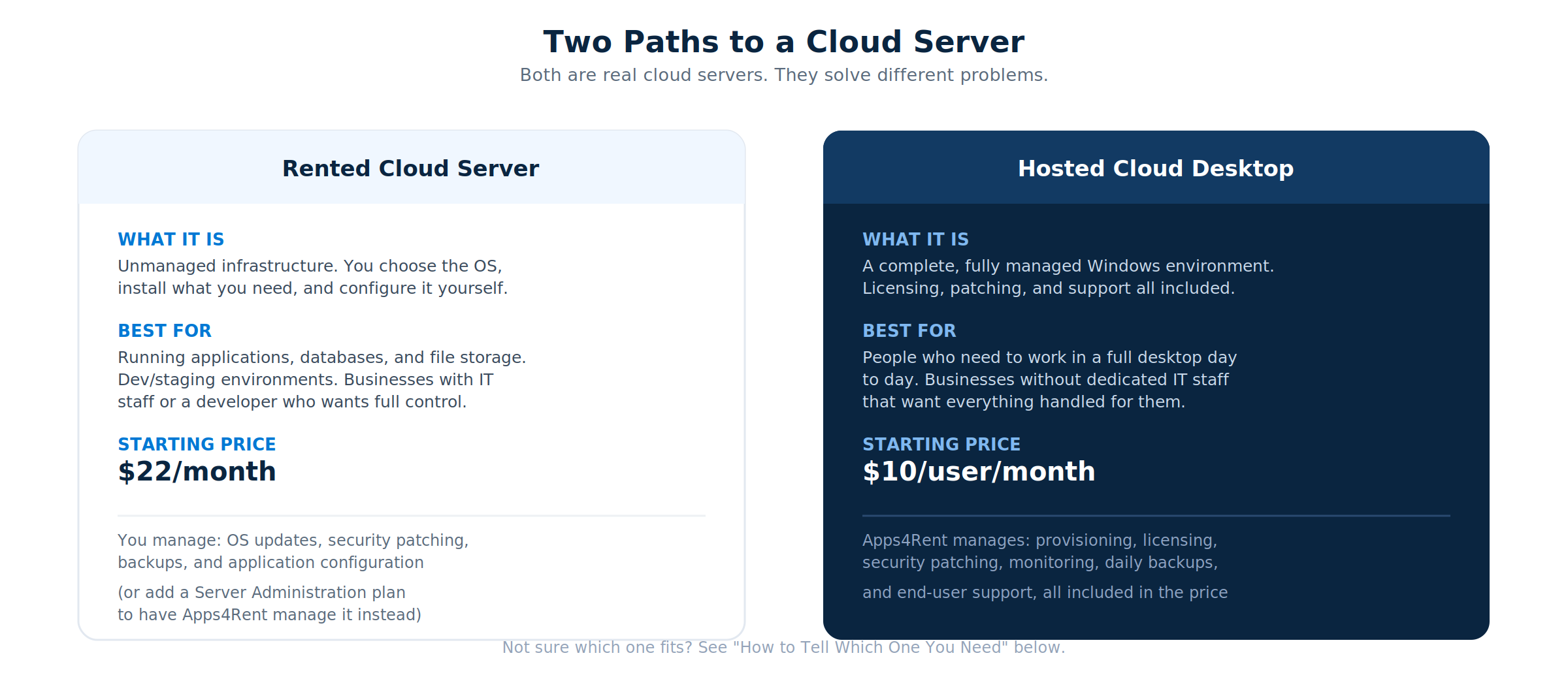
A rented cloud server starts at $22 per month and gives you unmanaged infrastructure: choose your operating system, Windows or Linux, install what you need, and configure it the way you would a physical machine. It’s the right building block for hosting a business application, running a database, standing up a development or staging environment, or serving as a DNS or file server. If you’d rather not manage it yourself, Apps4Rent’s Server Administration plans layer management on top without changing the underlying product.
A hosted cloud desktop starts at $10 per user per month and is the opposite by design: a complete Windows environment where provisioning, licensing, security patching, monitoring, daily backups, and end-user support are all included in one price. Nobody on your team needs Windows Server expertise to keep it healthy, because none of that responsibility sits with your team at all.
How to Tell Which One You Need
A few direct questions settle this for most businesses faster than a feature comparison does.
- Are you trying to give people somewhere to work, or somewhere for an application to run? People working day to day, checking email, running QuickBooks, saving documents, point toward a hosted desktop. An application, database, or website that runs largely unattended points toward a rented server.
- Do you have anyone in-house who can manage a Windows Server? If yes, and you want that control, a rented server keeps you in charge of configuration. If no, a hosted desktop removes that requirement entirely, since Apps4Rent handles it.
- How many people need access, and to what? A handful of people all needing the same full desktop experience is the classic hosted-desktop case. A single application that many people access through a browser or thin client is often better served by a rented server running that application.
- What’s your tolerance for a fixed monthly bill versus a bill that changes based on what you install and how you configure it? Hosted desktops are predictable by design. Rented servers give you more control over cost and configuration, which also means more responsibility for keeping both in check.
Many small businesses land on needing both, a rented server running a line-of-business application or database, and hosted desktops for the team accessing it day to day. That’s a normal, common architecture, not a sign you did the evaluation wrong.
Three Real Scenarios
A 12-person accounting firm running QuickBooks Desktop for multiple staff, with everyone needing the same familiar Windows environment day to day, is a clear hosted desktop case. Nobody on staff wants to manage Windows Server patching between tax deadlines, and the predictable per-user pricing makes budgeting straightforward during seasonal staffing changes.
A software development team that needs a staging environment to test builds before production, with a developer comfortable configuring the server themselves, is a clear rented server case. They want root access, control over exactly what’s installed, and no restrictions on how the environment is configured.
A 20-person manufacturing business running a specialized inventory management application that only a few staff interact with directly, while the rest of the team needs general desktop access for email and document work, often needs both: a rented server hosting the inventory application, and hosted desktops for the broader team, connecting to that application as one of several tools in their daily environment.
What a Rented Cloud Server Actually Costs
Apps4Rent’s rented cloud servers start at $22 per month for base infrastructure. That figure covers the server itself, compute, storage, and network connectivity in a SOC 2 Type II certified data center. It does not include Windows Server licensing, application licensing, or ongoing management, those are separate line items depending on what you install and whether you want Apps4Rent’s Server Administration plans handling upkeep for you.
This is the honest, and often overlooked, part of comparing rented server pricing against a hosted desktop’s all-in monthly price: a $22 rented server and a $10 per user hosted desktop are not directly comparable numbers until you’ve added licensing and management to the server side. For a single application server with no per-user licensing complexity, a rented server is very likely the cheaper path. For a full desktop experience for a team, once Windows licensing and administration time are factored in, the comparison shifts, which is exactly why the physical-server cost breakdown below matters as context.
If your rented server is going to support more than one or two people connecting to it remotely for a full desktop-style session rather than just running a background application, that’s the point where RDS CAL licensing enters the picture, a separate Microsoft licensing requirement that a straightforward application or database server doesn’t trigger. Apps4Rent’s virtual dedicated server plans support both Windows and Linux, including a choice of Windows Server versions, which is worth deciding on upfront since it affects both licensing cost and which applications will run without compatibility issues.
The True Cost of Keeping a Physical Office Server
For businesses weighing a cloud server, rented or hosted, against keeping a physical server in the office, the physical option’s cost is almost always underestimated, because most of it is invisible until you add it up deliberately.
-
Hardware acquisition and replacement. A typical small business server capable of supporting 5 to 15 users costs $4,000 to $8,000 upfront, and servers need replacing roughly every 5 to 7 years as performance and vendor support decline.
-
Maintenance and IT support. Whether handled internally or through a managed service provider, ongoing patching, configuration changes, and troubleshooting typically run $1,200 to $3,600 annually for a small server environment, and that figure climbs quickly the moment something actually breaks.
-
Backup systems. A proper backup strategy for a small server, external drives, cloud backup software, or a dedicated backup appliance, typically adds $500 to $2,000 annually. Skipping this isn’t really an option; it’s deferring a much larger cost to whenever the server eventually fails without one.
-
Downtime. A five-person office losing productivity for even a few hours during a server failure adds up fast at typical hourly labor rates, and unlike the other categories, this cost is unpredictable by nature rather than budgetable.
-
Power and physical space. A small business server running 24/7 typically consumes $50 to $150 in electricity annually, a modest figure on its own but one more line item in a total that keeps growing as you account for it properly.
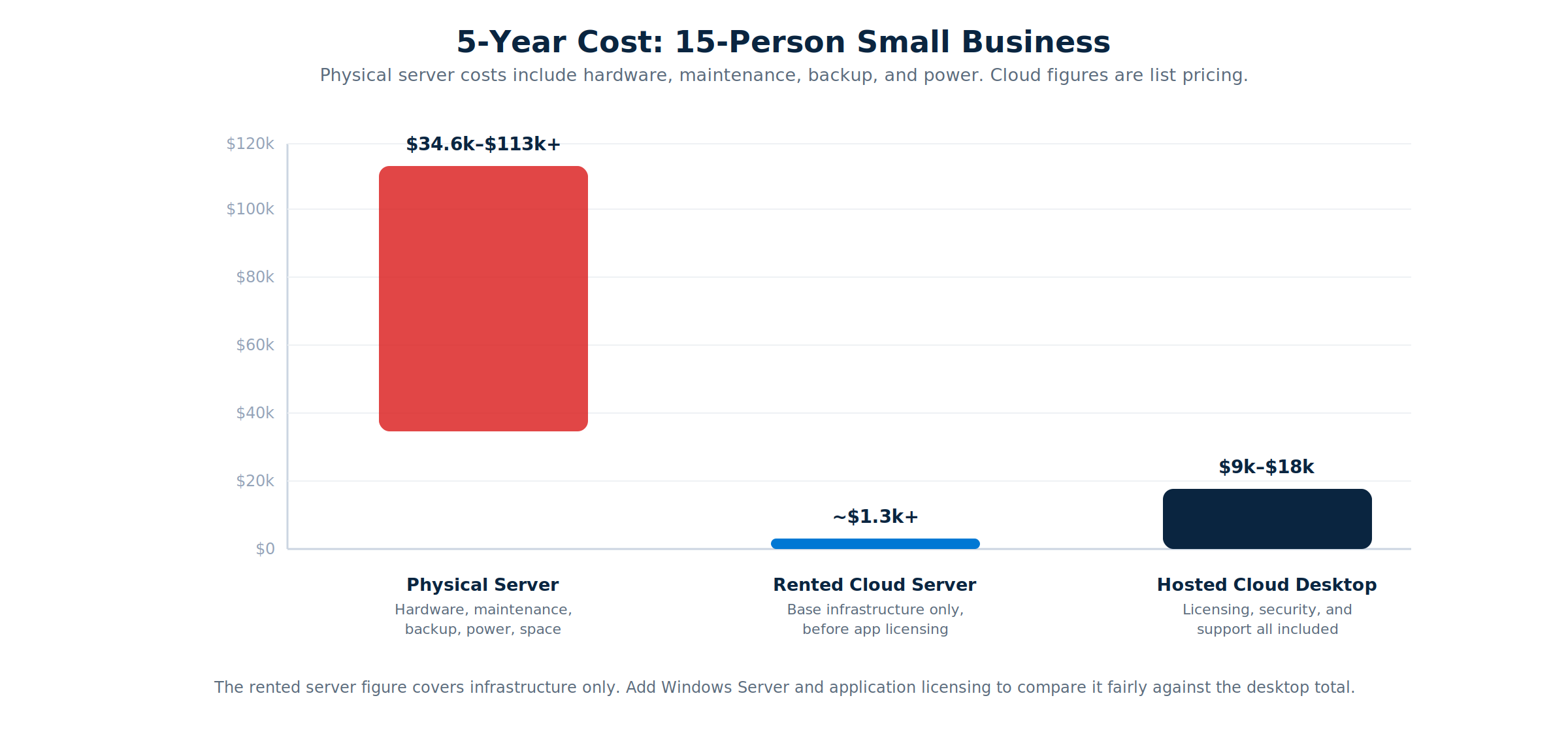
| Cost Category | Annual Cost |
|---|---|
| Hardware amortized (5-year lifecycle) | $800–$1,600 |
| IT maintenance and support (5-15 users) | $1,200–$3,600 |
| Backup systems (software + hardware) | $500–$2,000 |
| Downtime (estimated productivity impact) | $500–$3,000+ |
| Power and physical space | $50–$150 |
| Total annual server cost | $3,600–$13,250+ |
Compare that to a hosted cloud desktop’s Silver Plan for a similar 15-person small business, roughly $150 to $300 per month, or $1,800 to $3,600 annually, all-inclusive, and the gap becomes clear once every physical-server cost category is actually counted rather than just the sticker price of the box itself.
Replacing Your Office Server with a Cloud Desktop
For the specific and common case of an aging office server, the direct answer is: for most small businesses, a hosted cloud desktop is the more natural replacement, not a rented server. Here’s the reasoning, not just the conclusion.
A typical office server isn’t really running one isolated application the way a rented cloud server is designed to. It’s usually doing several jobs at once, holding shared files, acting as a print server, sometimes running as a domain controller for logins and permissions, and generally serving as the infrastructure behind how people in the office actually work day to day. That’s a people-facing role, not an application-facing one, and a hosted cloud desktop replaces exactly that role: shared file access, centralized permissions, and a consistent place for staff to work, without anyone needing to know what a domain controller is anymore.
A rented server can technically replicate an office server’s functions, but doing so means rebuilding file shares, permissions, and print services yourself on new infrastructure, the same administrative work you were trying to get away from, just relocated to the cloud instead of eliminated. A hosted desktop sidesteps that rebuild entirely, since shared access, security, and file storage are already part of what’s included rather than something to configure from scratch.
The exception worth naming clearly: if your office server’s primary job is running one specific backend application or database that staff access through a browser or a thin client, rather than logging into the server itself to work, that’s closer to the rented server scenario described earlier in this guide. The “replace the office server” question and the “which cloud path fits” question usually point to the same answer, but not always, which is exactly why the decision framework above this section exists rather than a single blanket recommendation.
What a Hosted Cloud Desktop Actually Costs
Apps4Rent’s hosted cloud desktop plans start at $10 per user per month, and unlike the rented server side, that figure is genuinely all-inclusive: Windows licensing, security patching, daily backups, monitoring, and 24/7 support are bundled into the price rather than billed separately. Apps4Rent also allows multiple users per desktop environment on certain plans, which meaningfully reduces per-user cost compared to providers that require a fully dedicated environment per person regardless of actual usage.
For a 15-person team, that lands in the $150 to $300 monthly range depending on plan tier and resource needs, the figure used in the comparison above. No separate line items for Windows Server licenses, no separate backup software subscription, no separate line for “IT time spent patching,” because none of that sits on your side of the relationship.
Security: What Actually Changes When You Move to the Cloud
Security responsibility shifts differently depending on which path you take, and understanding that shift matters more than a generic “the cloud is more secure” claim.
On a rented cloud server, you inherit physical and network-level security from the data center, SOC 2 Type II certification, redundant power, and network infrastructure, but you retain responsibility for everything above that layer: OS patching, application security, access controls, and backup integrity, unless you add a Server Administration plan to hand that off.
On a hosted cloud desktop, that entire stack is handled for you. Centralized patch management means security updates apply to every session without anyone manually running Windows Update. Data lives in the data center, not on local devices, so a lost laptop means revoking credentials rather than recovering or wiping a physical machine. Session-level controls, MFA enforcement, USB restrictions, copy-paste limits between environments, are available centrally rather than configured device by device.
Both paths represent a real security improvement over a typical small business physical server, which usually has none of these controls formalized at all. Which one requires less ongoing effort from you is really the question, and a hosted desktop’s answer is consistently “none,” while a rented server’s answer depends on whether you’ve added management to it.
If You’re Migrating From an Existing Physical Server
For businesses moving off a physical server specifically, rather than starting fresh, the process follows a fairly consistent sequence regardless of which cloud path you choose.
- Assessment. Inventory what’s actually running on the current server, applications, shared files, user accounts, and any hardware dependencies like local printers, before deciding anything about the target environment.
- Environment setup. Provision the new rented server or hosted desktop environment and configure it to match what the assessment surfaced, before any data moves.
- Application installation. Install and configure the software your team actually uses, testing each one before rolling it out broadly, particularly line-of-business applications that don’t tolerate configuration mistakes well.
- Data migration. Copy files and databases to the new environment while keeping the original server intact and untouched until the copy is verified.
- Testing. Confirm applications, permissions, and data are all working correctly in the new environment with a small group before the full team depends on it.
- Cutover. Move users over, ideally in waves rather than all at once, keeping the old server available as a fallback for a defined window afterward.
If you’re specifically migrating individual office PCs to a hosted cloud desktop environment rather than consolidating a server, our step-by-step migration checklist covers that exact process in more depth, including how to handle inventory, application compatibility testing, and a phased cutover without disrupting a working day.
Not sure which path fits your situation?
Apps4Rent can review what’s actually running on your current server and tell you plainly whether a rented server, a hosted desktop, or a combination of both makes the most sense, and what it will actually cost. No obligation.
Why Apps4Rent for Either Path
Most providers specialize in one of these two products and will steer you toward it regardless of fit, since it’s the only thing they have to sell. Apps4Rent genuinely offers both, rented cloud servers starting at $22 per month and hosted cloud desktops starting at $10 per user per month, which means the recommendation you get is based on what your business actually needs rather than what’s on the provider’s own price list.
That’s backed by real infrastructure and credentials on both sides: SOC 2 Type II certified data centers, a Microsoft Solutions Partner with competencies across Modern Work, Security, Infrastructure, and Data & AI, an Intuit Authorized Standard Host for QuickBooks and tax applications, and an authorized Citrix and Google Cloud partner. Apps4Rent has served more than 10,000 businesses across 90+ countries over 18+ years, with 24/7 support available by phone, chat, and email regardless of which path you choose.
For businesses running specific line-of-business or accounting software, that dual capability matters in practice. A CPA firm might run QuickBooks on a rented server for the application itself while staff access it through hosted desktops, an architecture Apps4Rent supports natively rather than requiring two separate vendor relationships to assemble.
Common Mistakes When Choosing a Cloud Server
Comparing sticker prices instead of total cost. A $22 rented server and a $10 hosted desktop plan look directly comparable on price alone, but they’re not measuring the same thing. One is base infrastructure before licensing; the other is genuinely all-inclusive. Comparing them without accounting for that difference leads to a decision based on numbers that don’t actually represent the final bill.
Choosing based on what a single provider sells rather than what the business needs. Providers that only offer rented servers will frame every use case as a server problem. Providers that only offer hosted desktops will do the reverse. Neither framing is dishonest exactly, it’s just incomplete, and the business ends up with whichever product the provider happened to sell rather than the one that actually fits.
Underestimating the ongoing management burden of an unmanaged server. A rented server’s low starting price is genuine, but “unmanaged” means exactly that, patching, security configuration, and backup strategy all remain the customer’s responsibility unless a management plan is added. Businesses that choose the cheaper unmanaged option without accounting for who will actually maintain it often end up adding management after the fact, at which point the cost comparison against a hosted desktop looks different than it did at signup.
Migrating everything at once instead of in phases. Whether moving to a rented server or a hosted desktop, cutting over an entire team or every application simultaneously multiplies the disruption if something doesn’t work as expected. A phased approach, one department, one application, or one small group first, catches problems while the impact is still small.
Assuming the physical server’s replacement cost is the whole story. As the cost breakdown earlier in this guide shows, the hardware purchase price is often the smallest piece of a physical server’s real five-year cost. Businesses that only budget for hardware replacement, without accounting for maintenance, backup, and downtime, consistently underestimate what staying on-premises actually costs compared to either cloud option.
Frequently Asked Questions
-
What is a cloud server for a small business?
It’s infrastructure or a complete desktop environment hosted in a data center rather than on-premises. Depending on the provider and product, it can mean a rented, unmanaged server you configure yourself, or a fully managed hosted desktop that includes licensing, security, and support in one price.
-
Is a rented cloud server or a hosted desktop cheaper?
It depends on what you’re comparing. A rented server’s base price is lower, but it excludes licensing and management, which are separate costs. A hosted desktop’s price is all-inclusive. For a small team needing a full desktop experience, the hosted desktop is often the more accurate apples-to-apples comparison once every cost category on the rented server side is added in.
-
Can a small business use both a rented server and a hosted desktop?
Yes, and it’s a common architecture. A rented server can run a specific application or database, while hosted desktops give the team a place to access it and everything else they need day to day, without requiring two different vendors.
-
What happens to our data if the internet goes down?
Both options require an internet connection to access, which is a real trade-off compared to a fully offline physical server. Most business internet outages are measured in minutes to a few hours, and a mobile hotspot serves as an effective backup connection for continued access during an outage.
-
Can I keep my physical server running as a backup during the transition?
Yes, and it’s the recommended approach. Keeping the original server intact and accessible for a defined window after cutover, typically 30 days, provides a fallback if anything unexpected surfaces after the migration is otherwise complete.
-
Do cloud servers support industry-specific software like QuickBooks or Sage?
Yes. Both rented servers and hosted desktops can run accounting and industry-specific software. Apps4Rent is an Intuit Authorized Standard Host specifically for QuickBooks and other accounting and tax applications, including Sage, UltraTax, Drake, and more. This means the software runs in a configuration Intuit has reviewed and approved rather than an improvised setup.
-
How long does moving from a physical server to the cloud take?
For a small business, the full process, assessment through cutover, typically takes one to four weeks depending on the number of applications involved and how much data needs to move. Simple setups with few applications can move faster; environments with legacy or specialized software need more testing time before cutover.
-
Can I run my cloud server on Azure instead?
Yes. Apps4Rent offers managed Azure hosting as an alternative to its own rented server infrastructure, which is worth considering if your business already has other workloads running on Azure or specific compliance requirements tied to that platform. For most small businesses without an existing Azure footprint, a rented server on Apps4Rent’s own infrastructure is simpler to set up and typically less expensive.
-
What’s the difference between a rented cloud server and Azure Virtual Desktop or Windows 365?
A rented cloud server is unmanaged infrastructure you configure yourself. Azure Virtual Desktop and Windows 365 are both managed desktop platforms, closer to the hosted desktop path in this guide than the rented server path, though they differ from each other in pricing model and management complexity. Our comparison of Windows 365 and Azure Virtual Desktop covers that distinction if you’re evaluating those specific platforms rather than a general hosted desktop plan.
The physical server sitting in your office closet isn’t wrong, exactly, it’s just increasingly expensive to keep once every cost category is counted honestly. Whether the right replacement is a rented cloud server, a hosted desktop, or both depends entirely on what that server is actually doing for your business today, and that’s worth answering specifically rather than assuming one path fits every situation.