
AWS vs Azure: How to Assess Whether Migration Makes Sense
-
 Last updated: 29 September 2026
-
 AWS,Azure
 -
 Written by
Editorial Team
Written by
Editorial Team
Most “AWS vs Azure” content falls into one of two unhelpful categories: a feature checklist with no verdict, or a migration how-to that assumes you’ve already decided. Neither answers the question a team actually has when this topic comes up: does moving make sense for us, specifically, and what would it actually take?
This guide is built to answer that question. It compares AWS and Azure honestly, including where AWS is still ahead, walks through the real reasons organizations migrate, and gives you a structured way to assess your own environment before committing to anything. If you finish here with a clear yes, we’ll point you to the specific workload guide you need next.
Why Organizations Actually Migrate from AWS to Azure
Nobody migrates clouds for fun. The move happens when a specific, concrete reason outweighs the real cost of switching. The recurring ones:
- Licensing economics for Windows and SQL Server workloads. If your infrastructure leans Windows Server and SQL Server, Azure Hybrid Benefit lets you apply existing licenses with Software Assurance against Azure compute, cutting costs in a way AWS has no equivalent for. For a Windows-heavy estate, this is often the single largest number in the entire comparison.
- Microsoft 365 and identity consolidation. Organizations already running Microsoft 365 often want infrastructure identity unified under the same Microsoft Entra ID tenant rather than maintaining a separate AWS IAM model, reducing the number of places access has to be managed and audited.
- Mergers, acquisitions, and vendor consolidation. When two companies merge and one runs AWS while the other runs Azure, consolidating onto one platform is usually cheaper than maintaining both, and the platform with the stronger existing Microsoft relationship often wins that decision.
- Compliance and government contracting requirements. Organizations that need Azure Government or Microsoft GCC High for federal compliance don’t have an AWS-side equivalent that satisfies the same requirements, which makes the decision less a comparison and more a requirement.
- Contract and pricing leverage. Enterprise Agreement commitments, CSP relationships, and account team responsiveness vary enough between the two vendors that pricing and support experience alone sometimes tip the decision, independent of the technology.
None of these are “Azure is better than AWS” in the abstract. They’re specific conditions that make Azure the better fit for a specific organization. The assessment framework later in this guide exists to help you find out whether any of them actually apply to you.
AWS vs Azure: An Honest Comparison
Any comparison that declares an outright winner is selling something. The honest answer is that both platforms are mature, both can run nearly any workload well, and the differences that matter are specific rather than general.
| Category | AWS | Azure |
|---|---|---|
| Compute breadth | Widest instance family selection, mature Spot pricing, Graviton (ARM) price-performance advantage | Strong general-purpose coverage; narrower specialty instance selection than AWS |
| Serverless | Lambda is the most mature serverless platform, with the deepest event-source ecosystem | Azure Functions is capable and improving, narrower integration breadth than Lambda |
| Storage | S3 is extremely mature, with the deepest third-party tooling ecosystem | Blob Storage is functionally comparable for the large majority of use cases |
| Identity model | Policy-first IAM, granular but steeper to reason about at scale | Entra ID plus RBAC, and the natural choice if Microsoft 365 is already in use |
| Windows and SQL Server licensing | No equivalent to Azure Hybrid Benefit for existing Microsoft licenses | Azure Hybrid Benefit can meaningfully cut costs for Windows and SQL Server-heavy environments |
| Hybrid and on-premises integration | Capable via AWS Outposts and related services, less native to Windows environments | Deep advantage for organizations with existing Windows Server, Active Directory, or hybrid identity |
| Government and compliance | AWS GovCloud covers federal requirements | Azure Government and GCC High cover overlapping and, for some Microsoft-specific requirements, unique ground |
The pattern worth noticing: AWS tends to win on raw platform breadth and maturity, particularly for compute variety and serverless. Azure tends to win when Microsoft licensing, identity, or compliance requirements are already part of the picture. Neither of those is a universal argument, which is exactly why a generic comparison can’t make this decision for you.
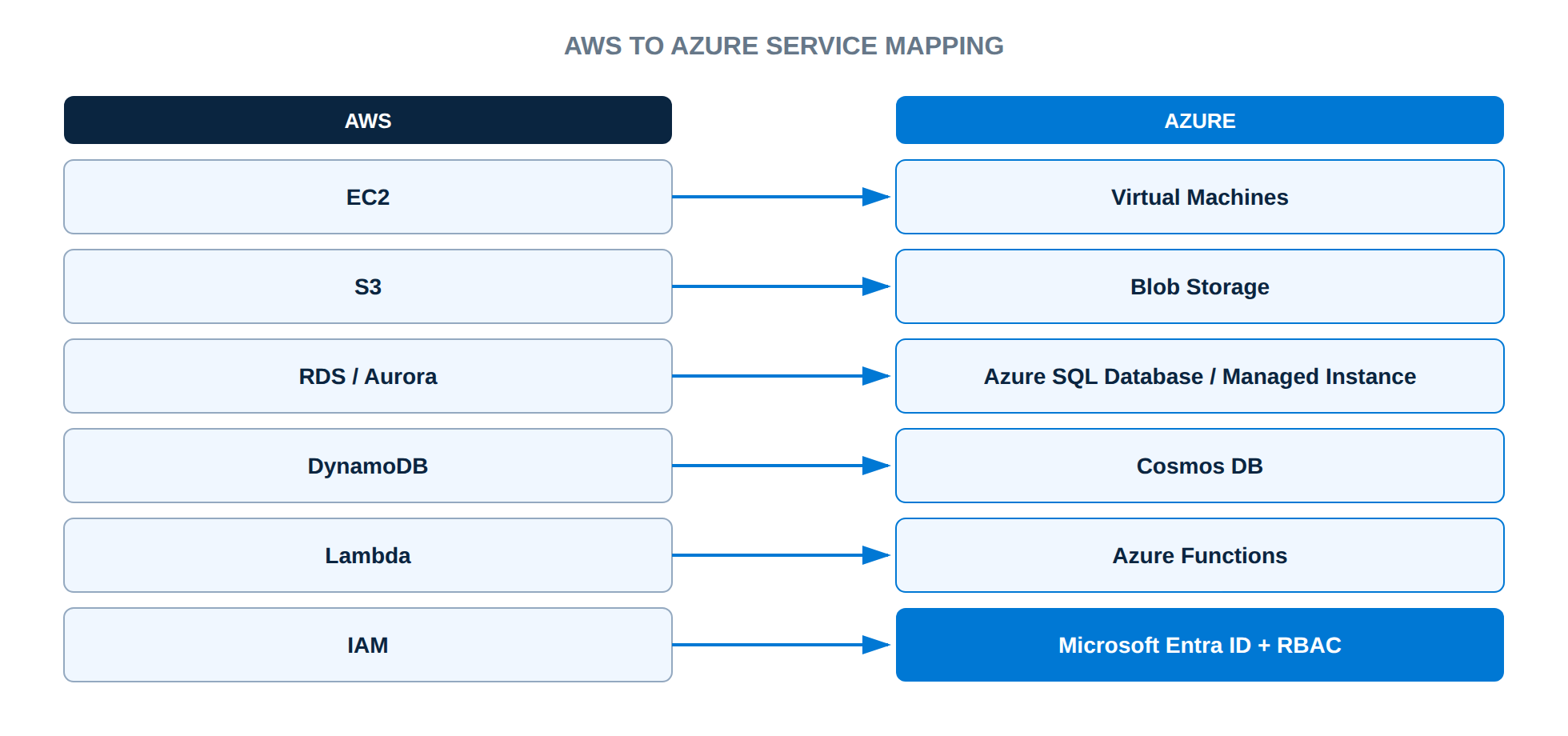
Core AWS services and their closest Azure equivalents. Most workloads map cleanly; a few need architectural rework rather than a straight swap.
AWS to Azure Service Mapping
Every migration eventually comes down to a service-by-service question: what does this specific AWS resource become on Azure? The mapping is close enough for most core services that migration planning is realistic, though a few require more than a like-for-like swap.
| AWS Service | Azure Equivalent | Migration Note |
|---|---|---|
| EC2 | Azure Virtual Machines | Near one-to-one for general-purpose workloads; specialty AWS instance families may need a different Azure SKU or a redesign |
| S3 | Blob Storage | Functionally comparable; review lifecycle policy and access tier differences before moving large datasets |
| EBS | Azure managed disks | Performance tiers map closely; re-benchmark IOPS-sensitive workloads after the move |
| RDS / Aurora | Azure SQL Database, Azure SQL Managed Instance, or Azure Database for MySQL/PostgreSQL | Engine-dependent; SQL Server workloads have the strongest migration tooling and licensing benefit here |
| DynamoDB | Azure Cosmos DB | Conceptually similar but not a drop-in API match; expect application-layer changes |
| Lambda | Azure Functions | Core concept maps directly; re-check event source integrations, since AWS’s ecosystem here is broader |
| VPC | Azure Virtual Network (VNet) | Subnetting and routing concepts transfer directly |
| IAM | Microsoft Entra ID + Azure RBAC | Different underlying model (policy-first vs. role-first); plan identity separately, not as an afterthought |
| KMS | Azure Key Vault | Comparable capability; key and secret migration needs its own short project |
| CloudFront | Azure Front Door / Azure CDN | Comparable; review custom origin and caching rule configuration |
The Real Cost Comparison: Beyond the Sticker Price
Comparing AWS and Azure on list price alone misses the variables that actually decide the number on your invoice:
- Azure Hybrid Benefit. If you hold Windows Server or SQL Server licenses with active Software Assurance, applying them against Azure compute removes a cost AWS simply doesn’t let you avoid the same way. For a Windows-heavy estate, this is frequently the deciding number in the entire comparison, not a minor discount.
- Reserved capacity flexibility. Both platforms discount committed usage, AWS through Reserved Instances and Savings Plans, Azure through Reservations and savings plans of its own. The mechanics differ enough that a direct commitment-for-commitment comparison needs modeling, not assumption.
- Data egress costs. Moving data out of either cloud carries a real cost, and if your architecture is heavy on cross-region or public-facing data transfer, this line item deserves its own line in the cost model rather than being estimated from compute alone.
- Support and account relationship costs. Enterprise support tiers, dedicated account teams, and CSP-based purchasing all shift the effective cost independent of the underlying infrastructure pricing.
- The migration project itself. Discovery, testing, parallel-running costs, and the internal time spent are real costs that belong in the comparison, not an afterthought once the decision is already made.
The honest way to model this: build the Azure cost estimate with Hybrid Benefit applied wherever you’re eligible, add a realistic migration project cost, and compare that total against your actual current AWS bill, not a generic published rate. Anything less specific isn’t a real comparison.
A Worked Example of Why the Comparison Isn’t Simple
Consider two organizations running an identical-looking workload: a SQL Server database on a mid-size VM, twenty-four hours a day. Organization A owns SQL Server and Windows Server licenses with active Software Assurance. Organization B has no existing Microsoft licensing and would need to license everything fresh. On AWS, both organizations pay essentially the same rate for equivalent EC2 and RDS capacity. On Azure, Organization A applies Azure Hybrid Benefit and pays only for the underlying compute, while Organization B pays the license-inclusive rate. The platforms look identical on a feature comparison chart; the actual invoices tell two completely different stories. This is exactly why “is Azure cheaper” has no single answer, and why the assessment has to be run against your specific licensing position, not a generic one.
Multi-Cloud: When Keeping Both Makes Sense
Full migration isn’t the only outcome a serious assessment can produce. Some organizations conclude that running AWS and Azure simultaneously, on purpose, is the right long-term answer rather than a temporary migration state. This usually holds up when:
- Specific workloads depend on an AWS-specific service, such as Lambda’s event ecosystem or a DynamoDB-based architecture, that would require a genuine rebuild to move, not just a migration
- Different business units or acquired companies each have deep operational expertise in one platform, and consolidating would cost more in retraining and risk than it would save
- Regulatory or customer contract requirements specify a particular cloud for certain data or workloads
- The organization wants deliberate vendor diversification as a risk management strategy, independent of cost
A deliberate multi-cloud strategy is different from an accidental one. The difference is whether each workload’s platform was chosen on purpose, with a documented reason, versus simply never revisited. The assessment framework above surfaces which category you’re actually in.
When Migration Doesn’t Make Sense Yet
An honest assessment sometimes concludes that migrating now is the wrong call, and that conclusion is worth taking seriously rather than treating as a sales objection to overcome. Signs that migration should wait:
- You’re mid-contract on a committed AWS spend. Reserved Instance or Savings Plan commitments with significant time remaining change the near-term math, even if the long-term case for Azure is sound.
- Your workloads are deeply built around AWS-specific services. If your architecture leans heavily on Lambda’s event integrations or DynamoDB’s specific capabilities, the rebuild cost may exceed the licensing or consolidation savings for years.
- You don’t have Windows or SQL Server licensing to bring over. Without Azure Hybrid Benefit eligibility, one of Azure’s strongest cost advantages doesn’t apply to you, and the comparison gets closer to a coin flip.
- There’s no forcing function. No compliance deadline, no M&A event, no contract renewal creating urgency. Migrating without a real driver, purely on the theory that Azure might be marginally better, rarely justifies the project cost and risk.
If any of these describe your situation, the right move is documenting why you’re staying on AWS for now and setting a date to revisit, not migrating anyway to avoid feeling like the assessment was wasted effort.
What a Real Assessment Should Actually Deliver
Not every “free assessment” offer produces something usable. Before agreeing to one, know what you should walk away with:
- A complete inventory, not a sample. Every EC2 instance, RDS database, S3 bucket, and Lambda function currently running, including the ones nobody remembered.
- A dependency map, showing which resources depend on which, so migration waves can be planned without breaking something on cutover day.
- A workload-by-workload recommendation, not a blanket “migrate everything.” Some workloads should move, some should wait, and some may never need to move at all.
- A real cost comparison using your actual licensing position, with Azure Hybrid Benefit correctly applied where you’re eligible, not a generic rate card.
- A phased timeline with a defined pilot workload, not a single all-at-once migration date.
If a proposed assessment can’t commit to producing these five things, it isn’t actually an assessment, it’s a sales pitch wearing an assessment’s name.
A 5-Step Framework for Assessing Your Migration
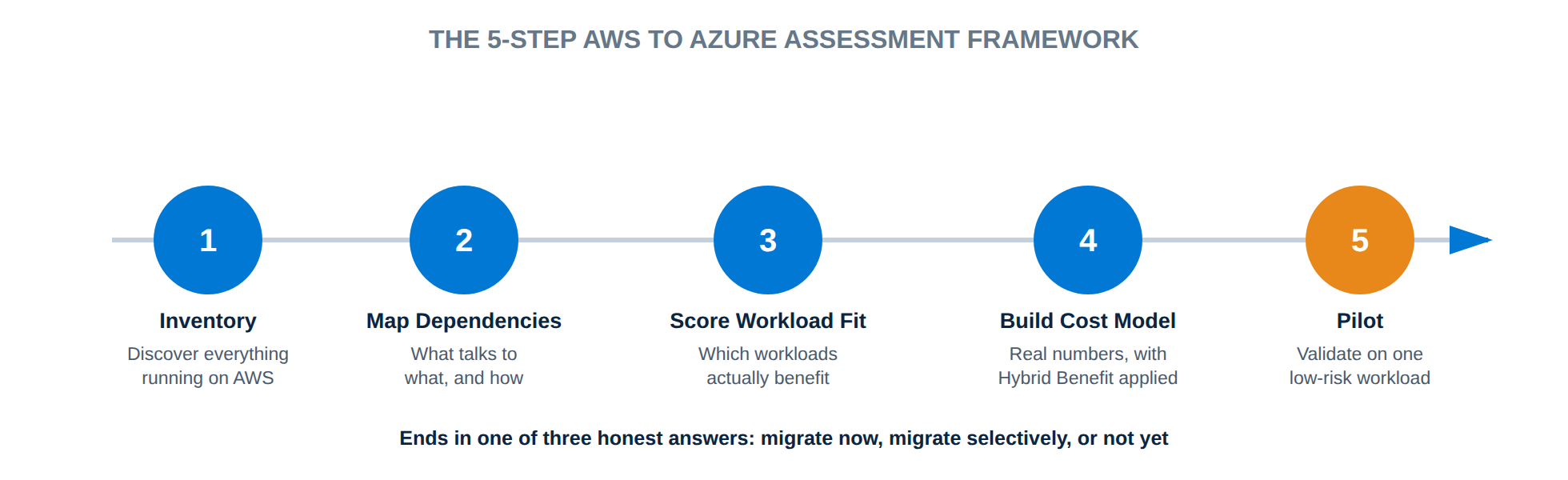
A structured assessment answers whether to migrate before anyone commits to how.
-
Inventory what you’re actually running
Full discovery of AWS resources: EC2 instances, RDS databases, S3 buckets, Lambda functions, and everything connected to them. You cannot assess a migration you can’t see completely, and this step routinely surfaces resources nobody remembered were still running.
-
Map the dependencies
Which services talk to which, and how often. A workload that looks simple in isolation can be tightly coupled to three other services that also need to move together, or the migration breaks something on cutover day.
-
Score each workload’s fit for Azure
Not every workload benefits equally. Windows and SQL Server-based systems tend to score well given Azure Hybrid Benefit; workloads deeply tied to AWS-specific services like Lambda’s event ecosystem or DynamoDB’s API may score lower and deserve more scrutiny before committing.
-
Build a real cost model
Using your actual inventory, actual licensing position, and actual usage patterns, not published rate cards. This is where the Hybrid Benefit and egress considerations above turn from a general discussion into a specific number for your environment.
-
Pilot before you commit
Migrate one low-risk, representative workload first. It validates your assumptions about time, cost, and compatibility on a small scale before you’re planning cutover windows for something business-critical.
An assessment done this way ends in one of three honest conclusions: migrate now, migrate selectively (some workloads move, others stay on AWS), or don’t migrate yet. All three are legitimate outcomes. If your current provider’s answer to an assessment is always “yes, migrate everything,” that’s worth noticing.
Migrating by Workload Type
Once an assessment concludes that migration makes sense, the actual work is workload-specific. Each type has its own tools, its own gotchas, and its own timeline, which is why we cover them as dedicated guides rather than cramming every workload into one generic walkthrough.
- Virtual machines. The most common starting point, typically handled with Azure Migrate for discovery, right-sizing, and replication. Our guide to migrating virtual machines from AWS to Azure covers the full process, from setting up your Azure Migrate project through cutover.
- Applications. Multi-tier applications, including SharePoint, Exchange, Project Server, Dynamics CRM, and accounting platforms, involve more than lifting a VM: identifying the right target resources and handling interdependent components correctly. See our guide to migrating applications from AWS to Azure.
- Databases. Moving SQL Server or other database engines from RDS to Azure is where Azure Hybrid Benefit has the most direct impact, and where choosing between Azure SQL Database, Managed Instance, or a VM-hosted deployment matters most. Our guide to migrating your database from AWS to Azure walks through the deployment options and steps.
- Storage. S3 to Azure storage migrations are usually the most mechanically straightforward part of a larger project, but bucket policies, lifecycle rules, and access patterns still need to be recreated deliberately rather than assumed. See our guide to migrating from AWS S3 to Microsoft cloud storage.
Most real migrations touch more than one of these categories in the same project, sequenced by the dependency map from step 2 above, not migrated in isolation.
Common Mistakes in AWS to Azure Migrations
- Skipping the assessment and going straight to migration. Teams that jump to “how do we move the database” without first asking “should we, and what will it cost” routinely discover the real number partway through the project, when reversing course is expensive.
- Treating AWS services as a literal one-to-one swap. DynamoDB and Cosmos DB are conceptually similar but not API-compatible; migrating that layer without expecting application changes is a common source of delayed timelines.
- Forgetting Azure Hybrid Benefit in the cost model. Comparing AWS pricing against Azure pay-as-you-go rates while ignoring Hybrid Benefit eligibility understates Azure’s real cost advantage for Windows and SQL Server-heavy environments, sometimes significantly.
- Migrating a workload without its dependencies. Moving a database while its application tier stays on AWS, even temporarily, introduces a cross-cloud network hop into every transaction until the rest catches up.
- No pilot. Committing to a full migration timeline based on assumptions rather than one validated, representative workload is where realistic schedules turn into missed ones.
How Apps4Rent Helps with AWS to Azure Migration
Apps4Rent is a Microsoft Solutions Partner and Tier-1 Cloud Solution Provider, SOC 2 Type II certified, serving over 10,000 businesses since 2003. We run AWS to Azure assessments and migrations as core, regular work, not a rare or unfamiliar request.
Our Azure consulting services include the full assessment framework above: discovery, dependency mapping, workload fit scoring, and a real cost model with Azure Hybrid Benefit applied correctly. When the assessment supports moving forward, the same team executes the migration through our Azure migration services, and once you’re running on Azure, our Azure managed services keep the environment monitored, patched, and cost-optimized going forward. As a Tier-1 CSP, we also handle Azure subscription provisioning and licensing directly, so assessment, migration, and ongoing management run through one accountable partner instead of being pieced together.
Not Sure If Migration Makes Sense for You Yet?
That uncertainty is exactly what an assessment is for.
Talk to an Apps4Rent Azure specialist. We will look at your actual AWS environment and give you a real answer, migrate, migrate selectively, or stay put, backed by numbers specific to you.
Frequently Asked Questions
-
Is Azure cheaper than AWS?
It depends entirely on your workload mix. Azure has a structural cost advantage for organizations with existing Windows Server or SQL Server licenses through Azure Hybrid Benefit, which AWS has no equivalent for. For workloads with no Microsoft licensing involved, the platforms are often closer in cost, and the real comparison requires modeling your specific usage rather than comparing published rates.
-
How long does an AWS to Azure migration take?
Timeline depends on workload count, complexity, and dependencies, not a fixed formula. A single VM or application can move in days once planning is complete; a full multi-workload environment with dependent databases and applications typically spans weeks to a few months. An assessment with a dependency map is what turns this from a guess into a real estimate.
-
Can I run AWS and Azure at the same time during migration?
Yes, and for most real migrations this is the norm rather than the exception. Workloads typically migrate in waves, with both environments running in parallel until each wave is validated and cut over, rather than a single all-at-once switch.
-
What is the hardest part of migrating from AWS to Azure?
Services with no direct API equivalent, such as DynamoDB to Cosmos DB, typically require application-layer changes rather than a straight lift-and-shift. Identity is the other common friction point, since AWS IAM and Microsoft Entra ID use different underlying models and need deliberate planning rather than an afterthought migration.
-
Does Azure Hybrid Benefit apply to workloads migrated from AWS?
Yes. Azure Hybrid Benefit is based on the Windows Server or SQL Server licenses you own with active Software Assurance, not on where the workload previously ran. A SQL Server database moving from AWS RDS to Azure is eligible the same way a database moving from on-premises would be.
-
Should I migrate everything at once or in phases?
Phased migration, sequenced by dependency and risk, is the approach that holds up in practice. Starting with a low-risk pilot workload validates your process before committing to a full timeline, and grouping dependent workloads into the same wave prevents a partial migration from breaking production traffic.
-
What AWS services don’t have a direct Azure equivalent?
Most core services map closely, but a few require more than a swap: DynamoDB’s API doesn’t match Cosmos DB’s directly, and Lambda’s event source ecosystem is broader than what Azure Functions currently integrates with. These gaps are workload-specific and worth identifying during assessment, not discovered mid-migration.
-
Can Apps4Rent assess our AWS environment before we commit to migrating?
Yes. Our Azure consulting services include a full assessment: discovery, dependency mapping, workload fit scoring, and a cost model specific to your environment with Azure Hybrid Benefit applied where eligible. The outcome is an honest recommendation, which may be to migrate everything, migrate selectively, or not yet.
Free, No-Obligation Assessment
Know the Real Number Before You Decide
Every environment is different. Get a workload-by-workload read on what migration would actually cost and take for yours, with Azure Hybrid Benefit factored in from the start.
Or call 1-866-716-2040 to talk it through first