
Understanding Oracle Cloud Infrastructure: A Complete Guide
-
 18 February 2026
-
 Cloud Computing,Oracle
 -
 Written by
Editorial Team
Written by
Editorial Team
Oracle is a globally renowned leader in the software industry, recognized as one of the largest and most influential companies in the world. It is renowned for its powerful and comprehensive ERP solutions, cutting-edge database management systems, and cloud infrastructure. Its cloud services, referred to as Oracle Cloud, is a versatile, subscription-based public cloud platform.
At its core, Oracle Cloud is built to empower enterprises by enhancing operational performance and agility. Oracle Cloud Infrastructure (OCI) is the term used to denote the provider’s cloud infrastructure. It is engineered to seamlessly integrate with existing business solutions while enabling the development of custom applications tailored to an organization’s specific requirements. Organizations, especially larger enterprises with unique or highly specialized requirements, can harness Oracle Cloud to craft the ideal infrastructure for their distinct workflows, eliminating the need to rely on external service providers.
Whether you’re looking to optimize legacy systems, migrate to the cloud, or develop entirely new cloud-native applications, Oracle Cloud provides the scalability and flexibility necessary for business success.
Key Oracle Cloud Technologies
Oracle Cloud offers the following services for enterprises.
- Infrastructure: Built on 25 GB Ethernet, OCI offers high throughput and low latency for seamless operations. Its network design ensures data is efficiently transferred, supporting a wide range of workloads with strong security and reliability.
- Applications: Oracle Cloud features a comprehensive suite of cloud-native applications, including ERP, CRM, and HCM solutions, designed to integrate seamlessly with its infrastructure, enabling businesses to improve operations and innovation.
- Autonomous Databases: Oracle’s autonomous databases automate critical tasks like provisioning, patching, and scaling, minimizing manual effort and ensuring consistent performance. This self-driving technology adapts to changing workloads, enhancing efficiency and reducing errors.
What are the Benefits of Oracle Cloud?
Oracle Cloud offers a variety of benefits that make it a powerful choice for businesses seeking high performance, flexibility, and cost-efficiency in their cloud infrastructure.
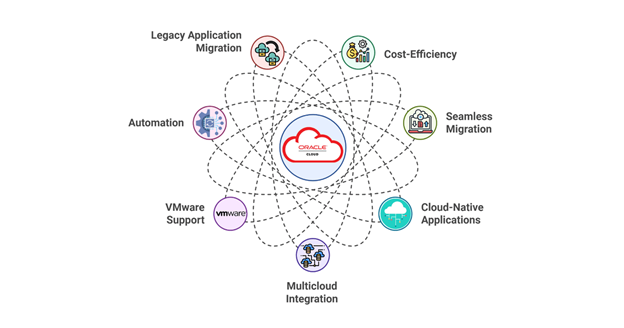
- Cost-Efficiency: Oracle Cloud stands out for its competitive pricing, particularly in storage and data migration. This allows businesses to keep costs down while still leveraging the cloud’s full potential.
- Seamless Migration for Oracle Workloads: Optimized specifically for Oracle workloads, Oracle Cloud makes it easier for existing Oracle customers to transition to the cloud, ensuring minimal disruption and faster deployment.
- Cloud-Native Applications and Scalable Performance: Offering a broad array of cloud-native applications, Oracle Cloud provides high-performance computing capabilities, enabling businesses to scale their operations efficiently as their needs grow
- Multicloud and Hybrid Cloud Integration: Oracle Cloud facilitates integration with other major cloud platforms like Microsoft Azure and AWS, allowing businesses to maintain a multicloud strategy. It also supports hybrid cloud deployments, offering greater flexibility in managing workloads across both on-premises and cloud environments.
- VMware Support and Cloud Elasticity: With full VMware support, Oracle Cloud VMware Solution (OCVS) allows organizations to run their VMware-based workloads directly on Oracle’s cloud infrastructure. This means businesses can maintain their VMware infrastructure with cloud-native benefits, without needing to re-architect applications.
- Automation for Effortless Management: Oracle Cloud automates critical processes such as database tuning, security, backups, and application scaling, reducing the manual effort required for system management and ensuring optimal performance around the clock.
- Legacy Application Migration Made Easy: Oracle Cloud’s enhanced scalability and security simplifies the migration of legacy applications, ensuring they run smoothly in the cloud without compromising on performance or security.
Drawbacks of Oracle Cloud
While Oracle Cloud offers many compelling benefits, it does come with certain limitations that may not suit every business.
- Integration Challenges with Non-Oracle Offerings: Oracle Cloud is optimized for Oracle products, which can create integration hurdles when attempting to work with non-Oracle technologies. This can be a challenge for businesses relying on a broader range of third-party solutions.
- Smaller Third-Party Ecosystem: Compared to industry giants like AWS and Microsoft Azure, Oracle Cloud has a smaller third-party ecosystem. This can limit the availability of pre-built applications, integrations, and tools, which may require more customization or third-party support.
- Brand Perception Issues: Oracle has struggled with past customer satisfaction, particularly around sales and support experiences. While the company has worked to improve, lingering negative perceptions may impact potential customers’ confidence in adopting Oracle Cloud.
- Complexity for Smaller Businesses: Due to its robust infrastructure and enterprise focus, Oracle Cloud’s architecture can be challenging for small and mid-sized businesses. It may require a higher level of expertise and resources to implement and manage effectively, making it less accessible for companies with simpler cloud needs.
Oracle Cloud Market Share and Competitors
Oracle holds a modest 2% market share in the cloud space, with industry leaders like AWS, Microsoft Azure, Google Cloud, and IBM Cloud dominating the landscape. While Oracle Cloud continues to evolve, it faces stiff competition from these established providers.
Key Differences and Considerations:
- AWS: As the dominant player in the cloud market, AWS offers an extensive range of services, a robust global infrastructure, and a large developer community. Its versatility makes it a go-to for organizations of all sizes seeking a comprehensive cloud solution.
- Google Cloud: Renowned for its strengths in artificial intelligence, machine learning, and data analytics, Google Cloud excels in handling large datasets. It offers a serverless platform and has a strong emphasis on open-source technologies, making it a great choice for innovation-driven businesses.
- Microsoft Azure: Microsoft Azure is highly favored by enterprises looking for hybrid cloud solutions and seamless integration with Microsoft’s suite of products. Its focus on blending on-premises and cloud resources makes it a natural fit for businesses with existing Microsoft investments.
- Oracle Cloud: A specialist in Oracle workloads, Oracle Cloud is optimized for database-centric applications. It stands out for its autonomous database features and robust security, offering a tailored solution for organizations with high-performance and data security requirements.
Ready to Elevate Your Cloud Experience?
Oracle Cloud is a powerful suite of technologies designed for enterprises that demand flexibility and uninterrupted operations. From its robust infrastructure to its cutting-edge autonomous databases, Oracle Cloud is tailored to meet the needs of businesses looking for a high-performance cloud platform. However, while it is ideal for Oracle workloads, Oracle Cloud may not be the perfect fit for everyone, especially those who rely on non-Oracle technologies or smaller third-party ecosystems.
At Apps4Rent, we specialize in providing managed cloud services for AWS, Microsoft Azure, and Google Cloud. Whether you’re migrating to the cloud or optimizing your infrastructure, our team can help you unlock the full potential of your cloud environment. Contact us today to learn how Apps4Rent’s cloud experts can support your business with reliable, scalable, and efficient cloud solutions tailored to your needs.