
What Is a Managed Security Service Provider (MSSP)? MSS Explained
-
 Last updated: 18 September 2026
-
 Azure
Azure -
 Written by
Editorial Team
Written by
Editorial Team
Security teams are drowning in the same problem regardless of company size: threats don’t stop at 5 p.m., but most internal IT teams do. The 2026 Verizon Data Breach Investigations Report found that vulnerability exploitation, not stolen credentials, is now the single most common way attackers get in, accounting for 31 percent of breaches, and ransomware was present in 48 percent of them. IBM’s 2026 Cost of a Data Breach Report put the global average cost of a breach at $4.99 million, a record high, up 12 percent year over year. For most organizations, building and staffing a round-the-clock security operation in-house simply isn’t realistic. That’s the problem managed security services exist to solve.
This guide explains what MSS, MSSP, and MSP actually mean, what a managed security engagement typically includes, how the work actually happens day to day, how to evaluate a provider, and how this fits into a broader managed cloud environment if your organization runs on Microsoft Azure.
What Is MSS? What Does MSS Stand For?
MSS stands for Managed Security Services: cybersecurity functions that an organization outsources to a third-party provider rather than staffing and running internally. Coverage varies by provider and package, but MSS commonly includes:
- Threat detection and monitoring
- Firewall management
- Vulnerability scanning
- Virtual private network (VPN) management
- Identity and access management (IAM)
- Endpoint protection
- Network security
- Compliance reporting
These services are typically sold on a subscription or consumption basis, which lets an organization pay for security capability at the scale it actually needs rather than the fixed cost of hiring a full internal team, and packages can usually be customized to an organization’s specific risk profile and industry.
What Is an MSSP?
An MSSP, or Managed Security Service Provider, is the third-party organization that delivers MSS. Most MSSPs operate through cloud-based security operations centers (SOCs), which lets them provide high-availability monitoring from anywhere at any time rather than requiring a physical presence at each client site. The specific mix of services varies from one MSSP to another, but the core value proposition is consistent: once engaged, a business can operate enterprise-grade security technology and expertise without the capital investment of building that capability internally.
What Is an MSP, and How Is It Different from an MSSP?
MSP stands for Managed Service Provider, and it covers the broader, general category of outsourced IT management: servers, cloud infrastructure, devices, applications, and end-user support. Security is typically one part of what an MSP offers, not the central focus, and many MSPs operate on a break-fix or as-needed basis rather than continuous 24/7 monitoring.
| Factor | MSP | MSSP |
|---|---|---|
| Full name | Managed Service Provider | Managed Security Service Provider |
| Primary focus | Broader IT operations | Cybersecurity specifically |
| Typical scope | Servers, cloud, devices, applications, end-user support | Security monitoring, threat detection, security tooling |
| What it delivers | Help desk and infrastructure support | Security operations and threat response |
| Role of security | One component among several | The central focus of the engagement |
In short: MSS is the set of services, an MSSP is the provider that delivers security services specifically, and an MSP is a provider generally focused on broader IT management, where security is one responsibility among many rather than the whole engagement. Understanding which category a provider actually falls into makes it much easier to evaluate whether they can deliver what your business needs, since some vendors market themselves loosely across both categories.
The Core Components of Managed Security Services
-
Managed Detection and Response (MDR)
MDR combines technology and human security analysts to detect threats and respond to them, with continuous, round-the-clock monitoring rather than periodic checks.
-
Intrusion Detection and Prevention Systems (IDPS)
An intrusion detection system (IDS) alerts when a potential threat is identified; an intrusion prevention system (IPS) goes a step further and actively blocks or contains the threat.
-
Security Information and Event Management (SIEM)
SIEM platforms aggregate security data from across an environment, servers, endpoints, network devices, and applications, into a single place, which lets analysts spot patterns and unusual activity that would be invisible looking at any one system alone.
-
Security Operations Center (SOC)
A SOC is the team, whether in-house or outsourced, responsible for continuously monitoring an environment and responding when something looks wrong. For most organizations below enterprise scale, an outsourced SOC through an MSSP is the only realistic way to get true 24/7 coverage.
-
DDoS Protection
Distributed denial-of-service protection keeps applications and websites available during an attack designed to flood a system with junk traffic until it slows to a crawl or falls over entirely.
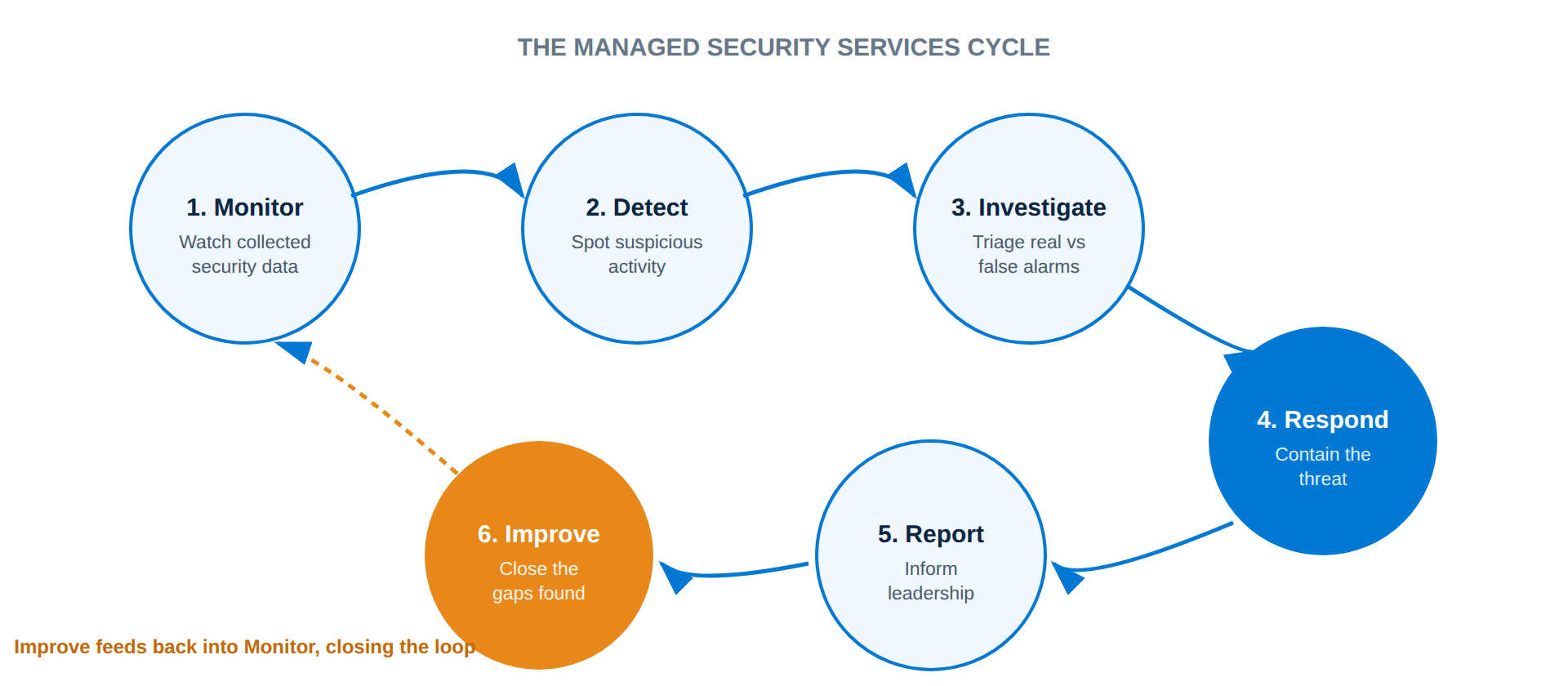
The six-stage cycle behind every managed security services engagement. Improve feeds back into monitor, so the cycle strengthens itself over time.
How Do Managed Security Services Actually Work?
MSS combines technology, continuous monitoring, and human security expertise into a repeatable operational cycle:
- Monitor. The provider continuously watches data collected from security tools across the environment for anything unusual.
- Detect. Analysts, often supported by automated tooling, look for suspicious activity: failed login attempts, malware signatures, unexpected configuration changes, and similar red flags.
- Investigate. Not every alert is a real attack. The MSSP triages each alert to determine whether it warrants further action or was a false positive.
- Respond. If an alert turns out to be a genuine incident, the provider acts to contain it, which might mean blocking malicious traffic, disabling a compromised account, or isolating an affected endpoint from the rest of the network.
- Report. Findings are communicated back to the organization’s leadership or IT team so they understand what happened and whether further action is required on their end.
- Improve. Lessons from monitoring and incident response feed back into the security posture, closing gaps that were exposed and reducing the odds of a repeat.
Why Do Businesses Need Managed Security Services?
- Continuous monitoring. Attackers don’t confine themselves to business hours, and a security program that only watches during the workday leaves a predictable gap.
- The cybersecurity skills gap. Many small and midsize businesses simply don’t have security expertise on staff, and hiring for it is expensive and competitive.
- Remote work exposure. Employees working from home frequently rely on home networks that were never hardened the way an office network would be, and human error remains the weakest link in most security programs, widening the attack surface further.
- Compliance pressure. Organizations are increasingly held responsible for how they protect client and customer data, and MSS can support the continuous monitoring and reporting that compliance frameworks expect, including maintaining documentation such as a written information security plan.
Signs Your Organization Needs Managed Security Services Now
The reasons above are the general case for MSS. In practice, a handful of concrete signals tend to be what actually prompts a business to act:
- Security alerts are piling up faster than anyone on the team has time to investigate them, so some get a quick glance and most get ignored
- Nobody can say with confidence what happens if a serious incident is discovered outside business hours
- An audit, client contract, or cyber insurance renewal now requires evidence of continuous monitoring the organization doesn’t currently have
- The business has grown into more cloud services, remote employees, or third-party integrations than the current security setup was designed to cover
- Security has effectively become one person’s part-time responsibility on top of an unrelated full-time job
Any one of these on its own is a reasonable prompt to start evaluating providers. More than one at the same time usually means the gap is larger than it looks from the inside.
The Real Benefits of Managed Security Services
- 24/7 security expertise without burning out an internal team trying to cover nights, weekends, and holidays.
- Faster identification and containment of threats, since a dedicated provider is actively watching rather than discovering an issue after the fact.
- A stronger overall security posture from the combination of continuous monitoring, prevention, rapid response, and ongoing improvement.
- Scalability through flexible packages that grow with the business instead of requiring a re-hire every time the environment changes.
- Cost-effective security that avoids the capital cost of building an internal team and SOC from scratch.
- The ability to monitor multiple cloud environments under one consistent, cost-effective approach.
- Simplified compliance, since providers help identify where an organization currently falls short of regulatory standards rather than leaving that discovery to an audit.
How to Choose a Managed Security Service Provider
-
Needs
Before evaluating any provider, understand your current security posture and what’s actually missing. A clear picture of your gaps determines which services are a genuine fit versus which are being upsold to you.
-
Availability
Confirm exactly what the provider monitors and manages, and verify they have real staff and resources available to respond during an actual emergency, not just a monitoring dashboard that generates alerts nobody acts on quickly.
-
Budget
MSS requires real investment. Compare pricing and included tooling against your budget, and factor in the cost of any additional services you’d otherwise have to purchase and integrate separately.
-
Expertise
A provider’s ability to handle a genuinely significant incident, not just routine alerts, is the real test of expertise. Look for a team of experienced security professionals, not just a technology platform.
-
Security scope
Depending on your needs, you may require MDR, SIEM, firewall management, endpoint protection, or some combination of these. Evaluate each carefully, and don’t pay for tooling your organization doesn’t actually need.
If you want an independent read on your current security posture before evaluating providers, our Azure consulting services can assess what’s already in place and where the real gaps are.
How Managed Security Services Are Priced
Pricing structures vary by provider, but most MSSPs use one of a few common models, and understanding the difference matters before you compare quotes.
- Per-device or per-endpoint pricing. A flat rate per protected device, server, or endpoint. Transparent and easy to forecast, but the total climbs directly with the size of your environment.
- Tiered flat-fee packages. Named plans (basic monitoring, standard response, full managed SOC) at fixed monthly prices, usually bounded by environment size or device count. Predictable for budgeting, but the coverage gap between tiers is where quotes deserve the closest reading.
- Percentage of infrastructure or IT spend. Less common for pure security services, but it appears in bundled managed services arrangements where security is one component of a broader monthly fee.
- Custom or usage-based pricing. Larger or more complex environments, especially those with specific compliance or multi-cloud requirements, often get a scoped quote rather than a published rate card.
Whatever the pricing model, get a precise, written answer to what’s actually included: is incident response part of the base price or billed separately when something happens? Are compliance reports included or an add-on? Is there a cap on the number of alerts or investigations covered before overage charges apply? A quote that looks cheaper on the surface is often missing exactly the coverage that matters most during a real incident.
MSSP vs Building an In-House Security Team
The realistic alternative to an MSSP isn’t hiring one security analyst, it’s building the team that genuine 24/7 coverage actually requires: multiple analysts to cover shifts around the clock, specialists across network security, identity, and endpoint protection, the SIEM and monitoring tooling itself, and ongoing training to keep pace with an evolving threat landscape. For most small and midsize organizations, that comparison favors an MSSP by a wide margin, since a managed services fee typically buys access to a full bench of specialized expertise for a fraction of what several full-time security hires would cost fully loaded.
That said, an in-house team can make sense for organizations with enough scale and complexity to justify it, particularly where deep institutional knowledge of a highly customized environment is itself a security advantage. The honest comparison isn’t “MSSP versus one security hire,” it’s “MSSP versus the team you’d actually need to replicate the same coverage,” and running that comparison plainly is usually what settles the decision.
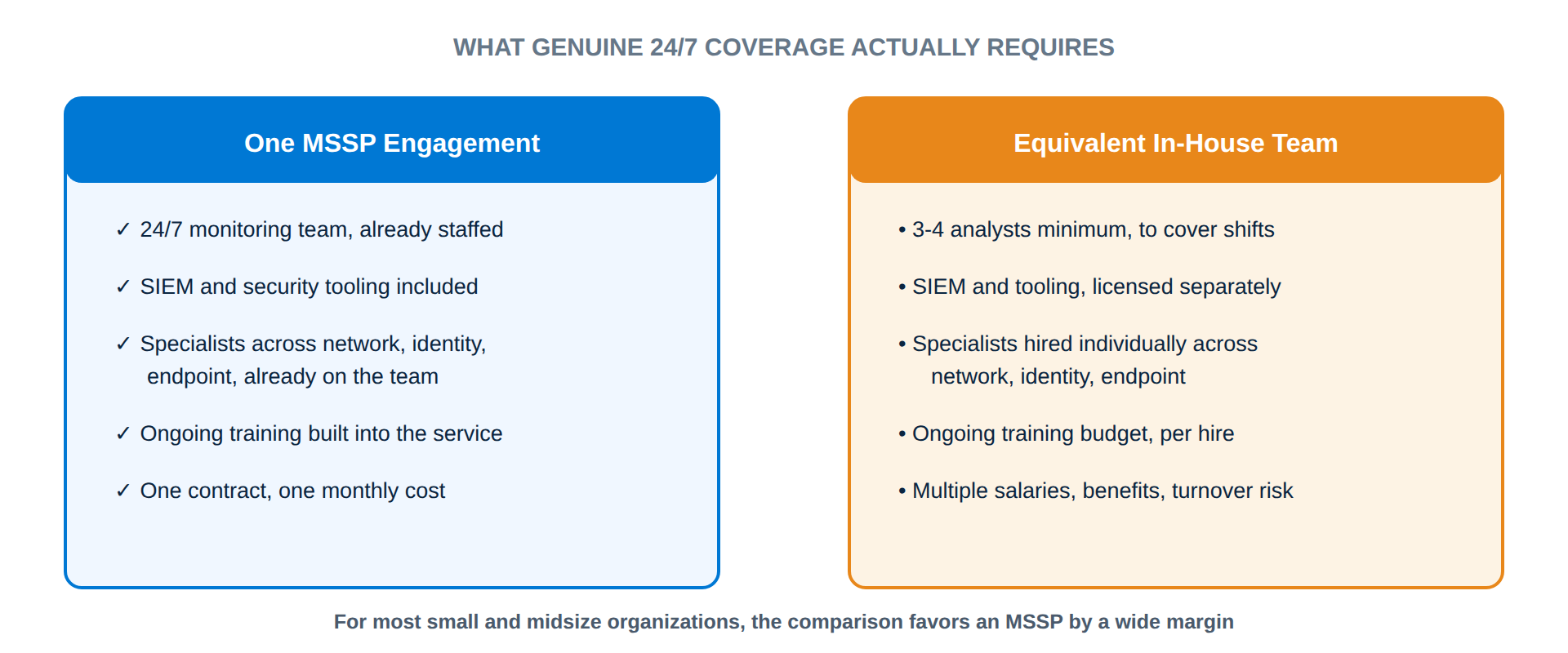
Genuine round-the-clock coverage requires more than one hire. This is the comparison that actually determines whether an MSSP makes financial sense.
Common Mistakes When Evaluating an MSSP
- Assuming “24/7 monitoring” means 24/7 response. A provider can watch your environment around the clock and still take hours to act on a real incident if their response team or escalation process isn’t equally available. Ask specifically about response times, not just monitoring hours.
- Treating compliance as automatically solved. As covered in the FAQ below, an MSSP contract doesn’t transfer your compliance obligations. Confirm exactly which controls the provider covers and which remain your responsibility.
- Comparing quotes on price alone. The cheapest quote often has the narrowest scope, which shifts the real cost onto you the first time something falls outside what was included.
- Not asking who actually owns an incident. When something goes wrong at 2 a.m., it should be clear in advance exactly who is authorized to act, not discovered in the moment.
- Picking a provider that doesn’t match your actual environment. A generalist MSSP may not have deep expertise in the specific platform you run on. If your infrastructure lives on Microsoft Azure, a provider with genuine Azure-native security expertise, not just generic security tooling layered on top, will typically deliver more coherent protection.
MSS, MSSP, and MSP at a Glance
| Term | What It Means |
|---|---|
| MSS | Managed Security Services, the security functions being outsourced |
| MSSP | Managed Security Service Provider, the company delivering those services |
| MSP | Managed Service Provider, generally focused on broader IT management with security as one part of the offering |
Understanding these terms, and which one actually describes a given vendor, makes it much easier to determine what your business needs and whether a provider you’re evaluating can genuinely deliver it.
Where This Fits If You’re Running on Microsoft Azure
Everything covered above describes managed security services in general, applicable to any infrastructure. If your organization runs on Microsoft Azure specifically, security doesn’t exist as a separate, bolted-on layer, it works best when it’s built into how your cloud infrastructure, identity, applications, and backups are already managed together. Several of the MSS components covered in this guide map directly to native Azure capabilities: Microsoft Sentinel functions as Azure’s SIEM, Microsoft Defender for Cloud provides threat detection and security posture management, Microsoft Entra ID handles identity and access management, and Azure DDoS Protection covers exactly what its name says.
Apps4Rent is a Microsoft Solutions Partner and Tier-1 Cloud Solution Provider, SOC 2 Type II certified, serving over 10,000 businesses since 2003. We provide managed Azure services with security controls built directly into hosted and managed environments, including firewalls, multi-factor authentication, DDoS protection, threat monitoring, endpoint protection, SSL, backups, and ongoing security analysis. That broader managed services approach covers Azure environment management, security policy enforcement, patching and updates, identity and access management, and backup and disaster recovery, delivered as one coordinated engagement rather than a security add-on layered awkwardly on top of a separately managed infrastructure. For a closer look at building defense-in-depth into that environment, see our guide to layered security architecture.
The Cost of Waiting
The statistics that opened this guide are worth returning to. A $4.99 million average breach cost, a record high, up 12 percent in a single year, and vulnerability exploitation now the leading way attackers get in, ahead of stolen credentials for the first time in the history of the Verizon DBIR. Nearly half of all breaches now involve ransomware. None of these numbers are abstract for a business that hasn’t yet decided how it would actually detect and respond to an incident outside business hours.
The organizations that avoid becoming part of next year’s statistics aren’t necessarily the ones with the biggest security budgets. They’re the ones that closed the gap between “we have some security tools” and “someone is actually watching, all the time, and knows what to do when something looks wrong” before they needed to find out the hard way. Whether that gap gets closed by building an internal team or engaging an MSSP, the point is closing it deliberately, on your own timeline, rather than during an incident.
Not Sure What Security Coverage You Actually Need?
Start with an honest look at what’s already in place and what’s missing.
Talk to an Apps4Rent specialist about your current environment, whether it’s on Azure or elsewhere. We’ll walk through what’s covered, what isn’t, and what a realistic next step looks like, no pressure to buy more than you need.
Frequently Asked Questions
-
Can an MSSP work alongside an existing IT team?
Yes. An MSSP can work alongside your internal IT team rather than replace it. A common arrangement has the internal team manage everyday technology and infrastructure while the MSSP handles agreed-upon security responsibilities such as threat monitoring, vulnerability management, and incident response.
-
Does using an MSSP automatically make my business compliant?
No. Working with an MSSP does not automatically make a business compliant with any regulation or industry standard. What an MSSP can do is help implement and continuously monitor the security controls that support those requirements, which meaningfully reduces the work of getting and staying compliant, but the responsibility for compliance itself still sits with the organization.
-
What should I ask an MSSP before signing a contract?
Ask exactly what systems they monitor, whether monitoring is genuinely available 24/7, how security incidents are handled end to end, who specifically responds to critical alerts, what’s included in the price versus billed separately, and which responsibilities remain with your own team. It’s also worth asking directly about their security practices, track record, reporting cadence, and ability to scale with your organization.
-
What types of businesses typically use managed security services?
Organizations of nearly every size and industry use MSS, but it’s particularly common among small and midsize businesses, healthcare organizations, financial and accounting firms, law firms, SaaS companies, and any business operating cloud-based or remote work environments where a full internal security team isn’t realistic.
-
How quickly does an MSSP respond to a security incident?
Response time depends on the specific provider, the service agreement in place, and the severity of the incident. If rapid response matters to your business, and for most organizations it should, review a prospective provider’s service-level agreements (SLAs) and escalation procedures carefully before signing anything.
-
What’s the difference between MSS, MSSP, and MSP?
MSS refers to the managed security services themselves, the outsourced cybersecurity functions such as monitoring, threat detection, and incident response. An MSSP is the company that delivers those services, with security as its central focus. An MSP is a broader category of IT provider that manages general infrastructure, devices, and applications, where security is typically one part of a wider service rather than the main focus.
-
How does managed security fit into a Microsoft Azure environment specifically?
On Azure, many core MSS components have direct native equivalents: Microsoft Sentinel serves as the SIEM platform, Microsoft Defender for Cloud provides threat detection and posture management, Microsoft Entra ID handles identity and access management, and Azure DDoS Protection covers denial-of-service defense. A managed Azure services provider can operate these tools as part of a single coordinated environment rather than treating security as a separate, disconnected layer.