
Best QuickBooks Hosting for CPA Firms (2026)
-
 16 March 2026
-
 QuickBooks
 -
 Written by
Editorial Team
Written by
Editorial Team
QuickBooks has long been the accounting platform of choice for CPA firms managing everything from client bookkeeping to multi-entity reporting. As firms grow and teams become more distributed, the question of where and how QuickBooks runs starts to matter as much as the software itself. Hosted QuickBooks has become an increasingly practical answer to that question, though whether it fits a particular firm depends on a few specific factors worth understanding before making the call.
Apps4Rent has navigated this conversation with CPA firms of all sizes as an Intuit Authorized Hosting Provider and the guidance here draws from that experience.
What QuickBooks Hosting Actually Means for a CPA Firm
QuickBooks hosting refers to running QuickBooks Desktop on a remote server managed by a third-party provider, accessed securely from any device or location. It is not QuickBooks Online. The two are separate products with different features, different pricing structures, and different use cases.
This distinction is worth establishing early. Firms that have already transitioned to QuickBooks Online and find it sufficient for their work are not the audience for hosted Desktop. QuickBooks Desktop hosting serves firms that need the depth and flexibility of the Desktop product and want to access it without owning or managing the underlying infrastructure.
Those firms tend to share certain characteristics. They handle complex client work — multi-entity reporting, detailed job costing, industry-specific workflows — where QuickBooks Online’s capabilities fall short. Many also run QuickBooks alongside professional tax software such as Lacerte, Drake, or ProSeries. These applications have no native cloud equivalent and having them coexist in the same hosted environment significantly reduces the friction of managing both. For firms in this position, moving to QBO is not simply a technology update. It carries real workflow cost, and a hosted Desktop is often the more sensible path.
The Real Problems QuickBooks Hosting Solves (and Which Ones It Doesn’t)
Hosted QuickBooks addresses a specific set of infrastructure challenges. Understanding where those begin and end leads to better expectations on both sides.
What hosting reliably solves:
- Multi-user access from different locations, without VPN dependencies or company file conflicts
- Version consistency, where every user works on the same build with no manual update coordination required
- IT overhead tied to maintaining physical servers, managing backups, and handling security patching
- File-sharing friction with clients or external collaborators who need access to the same company file
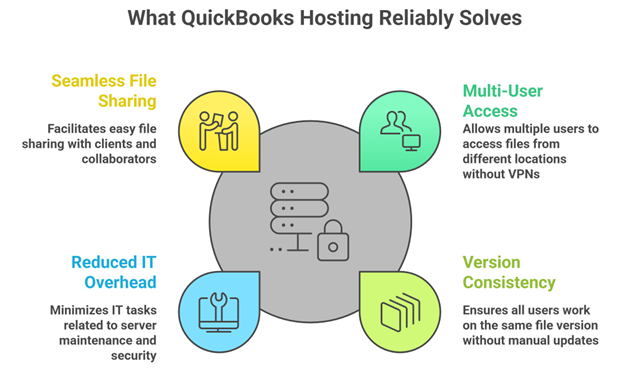
For CPA firms running QuickBooks Desktop on local infrastructure, these are recurring operational pain points. Hosting addresses all of them at the infrastructure level.
What hosting does not solve:
- Disorganized internal workflows or inconsistent bookkeeping practices
- Software compatibility issues unrelated to where the application is hosted
- Staff alignment or training gaps around how QuickBooks is used day to day
Moving QuickBooks to a hosted environment changes the infrastructure. It does not change how the firm operates within it. Firms with sound internal processes get the most from hosting because the platform stops being a source of friction and simply works. Firms expecting infrastructure change to substitute for process improvement are likely to find the results underwhelming.
When QuickBooks Hosting for CPA Firms Is Worth It
Several firm profiles consistently find strong value in hosted QuickBooks Desktop. They have been listed below:
-
Firms with three or more staff accessing QuickBooks simultaneously
Multi-user Desktop on local infrastructure frequently creates file access conflicts and requires careful coordination across the team. Hosting resolves this cleanly. The larger the concurrent user count, the more immediately the return is felt.
-
Firms running QuickBooks alongside dedicated tax software
Lacerte, Drake, and ProSeries operate best when housed in the same environment as QuickBooks. A hosted setup that holds all relevant applications in one place removes the operational complexity of managing them across separate systems or locations.
-
Firms handling complex or multi-entity client engagements
QuickBooks Online continues to improve, but it still presents limitations for firms managing multiple entities, advanced inventory, or detailed job costing. Desktop remains the stronger platform for this work, and hosting makes it accessible without the infrastructure cost.
-
Distributed or hybrid teams
For firms with staff working across locations, hosted QuickBooks provides consistent, secure access without requiring VPN configurations or device-specific setups. Remote access becomes reliable rather than improvised.
-
Firms looking to exit server management without changing platforms
Not every firm wants to migrate to a new product. Some simply want their existing software to run more reliably and cost less to maintain. Hosting is the most direct path to that outcome.
When It May Not Be Worth It
A sole practitioner or small two-person firm running straightforward work on QuickBooks Online already has a functional cloud-based setup. Layering hosted Desktop on top adds cost without adding meaningful capability. Similarly, firms that are actively transitioning to QBO and phasing out Desktop use are better served completing that migration than investing in hosted infrastructure they plan to retire.
On a small scale, the economics also warrant a closer look. For a firm with one or two users and predictable, low-complexity workflows, the monthly cost of hosted QuickBooks Desktop may not produce savings over a well-maintained local setup. The value proposition strengthens at three or more concurrent users, but below that, the case is genuinely thinner and worth evaluating honestly.
What to Evaluate When Choosing the Best QuickBooks Hosting for CPA Firms
Selecting a hosting provider involves more than comparing feature lists. A few targeted questions reveal more about a provider’s suitability than any checklist.
-
Is the Provider Intuit Authorized?
Intuit authorization ensures the host receives QuickBooks updates directly from Intuit, keeping version compatibility intact and delivering payroll updates on schedule. For a CPA firm during tax season, a delayed update from an unauthorized provider carries real operational risk. Current authorization status should be confirmed, not assumed.
-
What do the uptime SLAs actually cover?
A 99.9% uptime figure requires context. Understanding what is included, how downtime is defined and measured, and what remediation applies when the SLA is breached matters significantly more than the headline number. Data center redundancy and geographic failover are worth discussing specifically.
-
Does the security posture meet CPA compliance requirements?
CPA firms hold sensitive client financial data, and professional liability makes security posture a substantive concern rather than a checkbox exercise. SOC 2 Type II certification, encryption at rest and in transit, role-based access controls, and audit logging are the relevant markers to look for.
-
How is multi-user licensing structured?
Licensing terms are among the most common sources of billing confusion with hosting providers. Understanding exactly what user count is included in base pricing, what triggers additional charges, and how the structure scales with firm growth prevents surprises later. This should be confirmed in writing before any agreement is signed.
-
Who handles QuickBooks-specific support issues?
General hosting support can address server-level issues. It typically cannot resolve a QuickBooks company file error, a payroll processing problem, or an application-specific integration failure. Knowing whether QuickBooks expertise sits within the provider’s support team is an important practical distinction.
-
What does migration and onboarding involve?
Moving an active QuickBooks company file to a hosted environment requires care and coordination. Understanding whether the provider manages migration, whether a testing period is available before go-live, and what, if any, downtime to expect sets the right expectations from the start.
The Cost Reality of QuickBooks Hosting for CPA Firms
Hosting reduces infrastructure costs; however, it does not eliminate it. Understanding what the subscription covers versus what remains the firm’s responsibility leads to more accurate budgeting.
A hosted QuickBooks environment typically includes server infrastructure, maintenance, automated backups, security monitoring, and software updates. QuickBooks Desktop licenses, any additional third-party software in the hosted environment, and firm-side hardware used to connect to the hosted session remain separate costs.
Total cost of ownership is a more useful frame than the monthly price alone. A physical server involves upfront capital, ongoing IT support, a hardware replacement cycle, and carries the variable cost of unplanned downtime or a security incident. Hosting converts that irregular and sometimes unpredictable cost structure into a consistent monthly subscription. For many firms, that predictability has operational value independent of whether the total annual spend is lower.
The right approach is to run the actual numbers against the firm’s current infrastructure costs rather than comparing hosting prices in the abstract.
The Bottom Line on QuickBooks Hosting for CPA Firms
For many CPA firms, hosted QuickBooks Desktop is a practical and well-suited solution. Firms running three or more concurrent users, working alongside professional tax software, handling complex client engagements, or operating across distributed teams consistently find that hosting removes operational friction and scales more cleanly than local infrastructure.
The firms where it delivers less tend to be those where the fit was never quite right — smaller practices already well-served by QuickBooks Online, or firms in active transition away from Desktop entirely.
Apps4Rent’s QuickBooks hosting service is built around both hosting capability and application expertise, backed by our Intuit Authorized Host standing. For CPA firms working through this decision, our team is available to talk through the specifics of your setup. Contact us today via chat, call, or mail to learn more about QuickBooks hosting solutions for your firm.

Request for price promotions